
Tournaments
Tournament software that knows board games aren’t chess
Most tournament tools assume two players and one board. Yours seats four to a table, needs placement points, and argues about tiebreakers — this one was built for that.
Built for the table, not the chessboard
Elimination
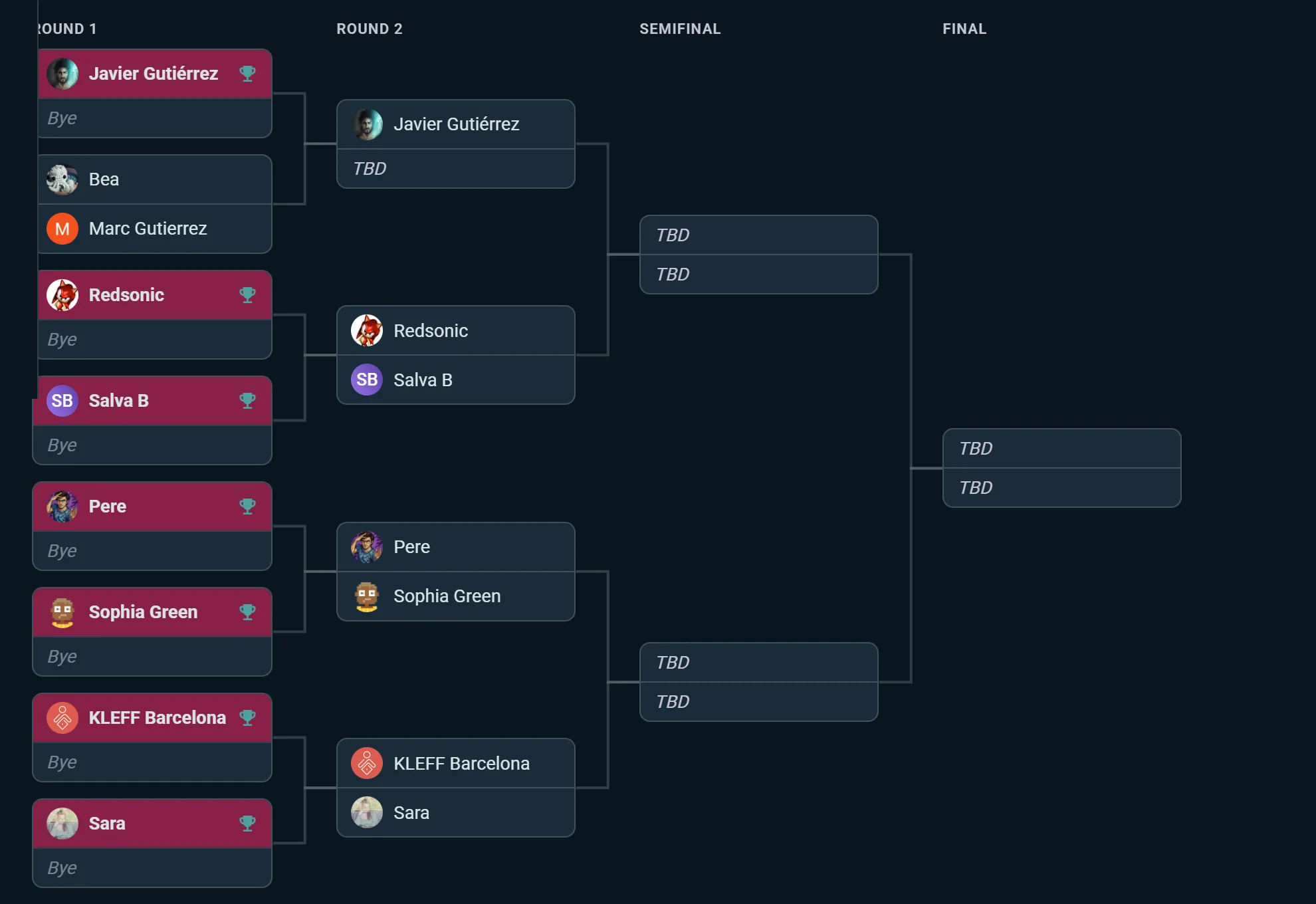
A proper bracket, drawn on screen
Single or double elimination: seed the field, confirm, and the bracket builds itself — byes resolved, winners advancing along the lines, the final waiting at the end.
- Seeding proposed, yours to reorder. The system suggests an order; you drag the final say.
- Byes handled. An odd field doesn’t break the tree — byes advance automatically.
- Double elimination too. Lose twice to go home — the fairer feel for a title decider.
Phases
Swiss heats, then a Top 8 — one tournament
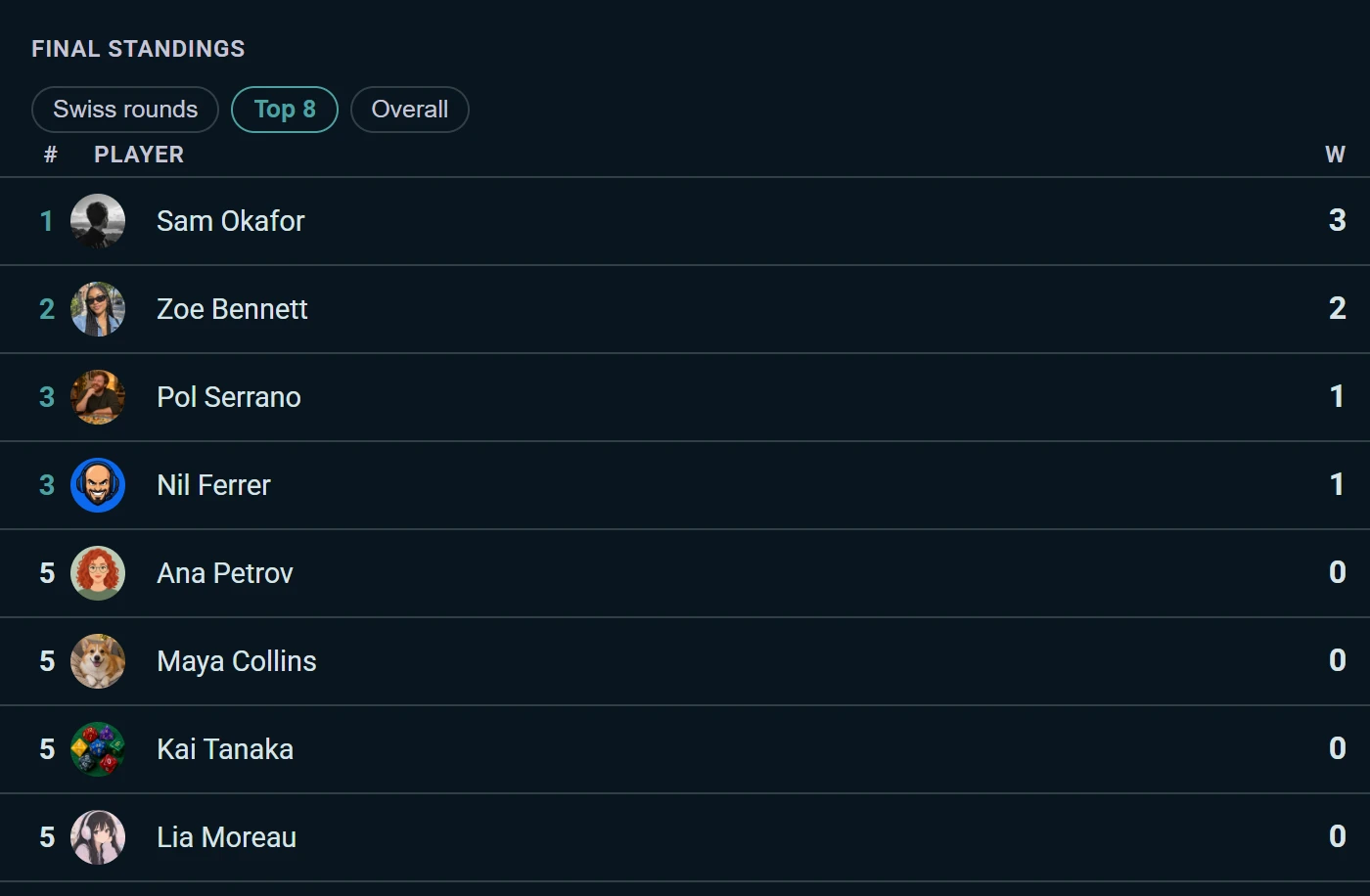
Chain phases, each with its own format and scoring. Sort the field with Swiss rounds, cut to the best, and let a bracket decide the title. Ludoya proposes the qualifiers, you confirm the seeding, and the whole field gets a final classification.
- Your cut rule. Everyone continues, the best N overall, or the best of each table in the final round.
- Seeding you can drag. Qualifiers come best first; reorder before you confirm and start.
- Championship and consolation. Split an elimination phase in two — the title above the line, the places below it underneath.
- Everyone gets a place. Places 1–8 from the bracket, 9th onwards from the heats — one Overall table, no arithmetic.
Swiss and mixer
Multi-player rounds, paired for you
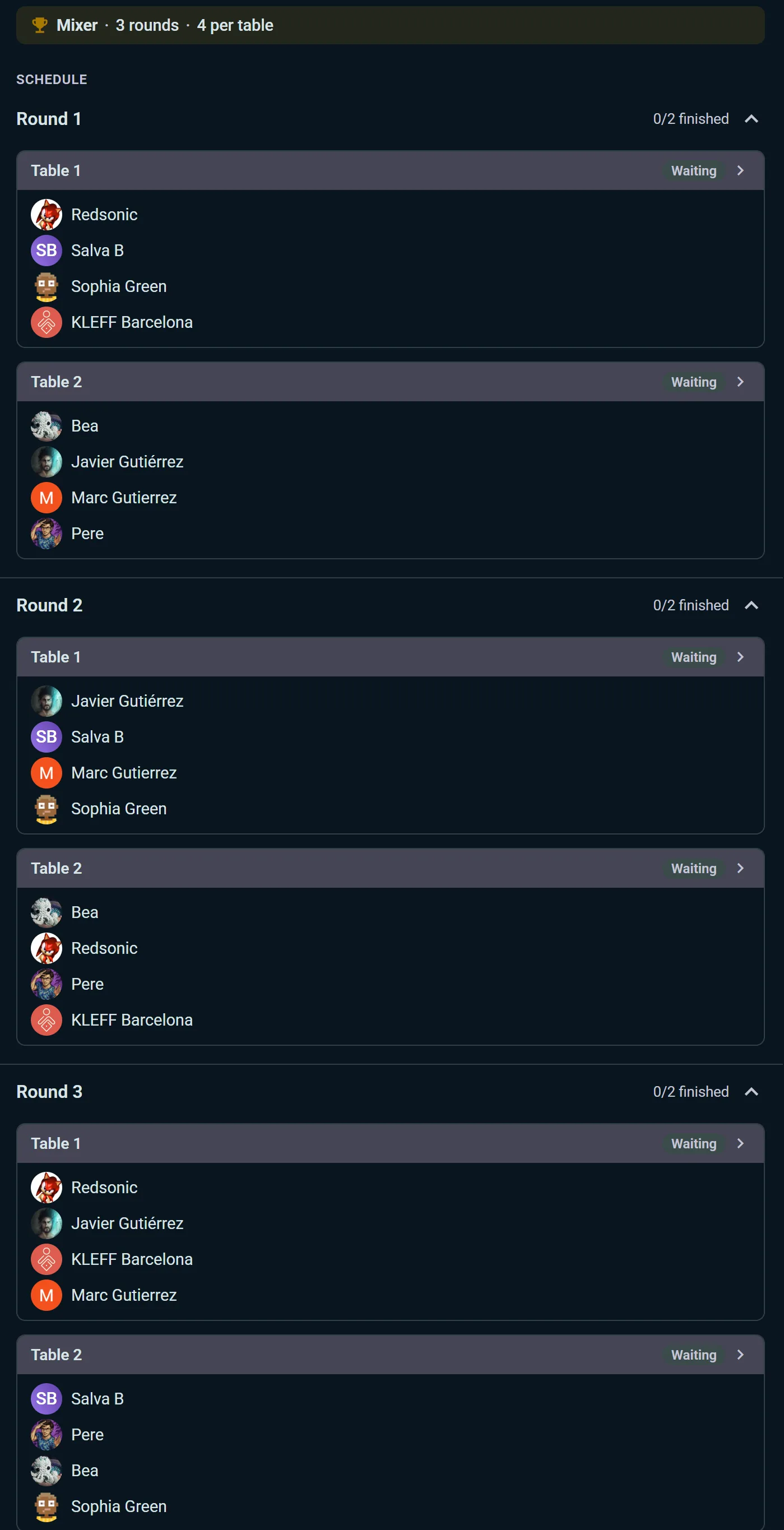
Swiss pairs players on similar scores as the rounds go; mixer builds the whole schedule up front to maximise how many different people everyone plays. Both seat three, four or more per table — which is what makes them work for board games.
- The whole night, planned up front. Three rounds, two tables each, and no two tables share a lineup — the mixing is the format.
- Rounds suggested for your field size. And overridable when the evening says otherwise.
- Points per placement. First, second, third at each table are worth what you decide, before anyone argues.
- Bye points. When the numbers don’t divide, sitting out doesn’t punish anyone.
Standings
Tiebreakers decided before the argument starts
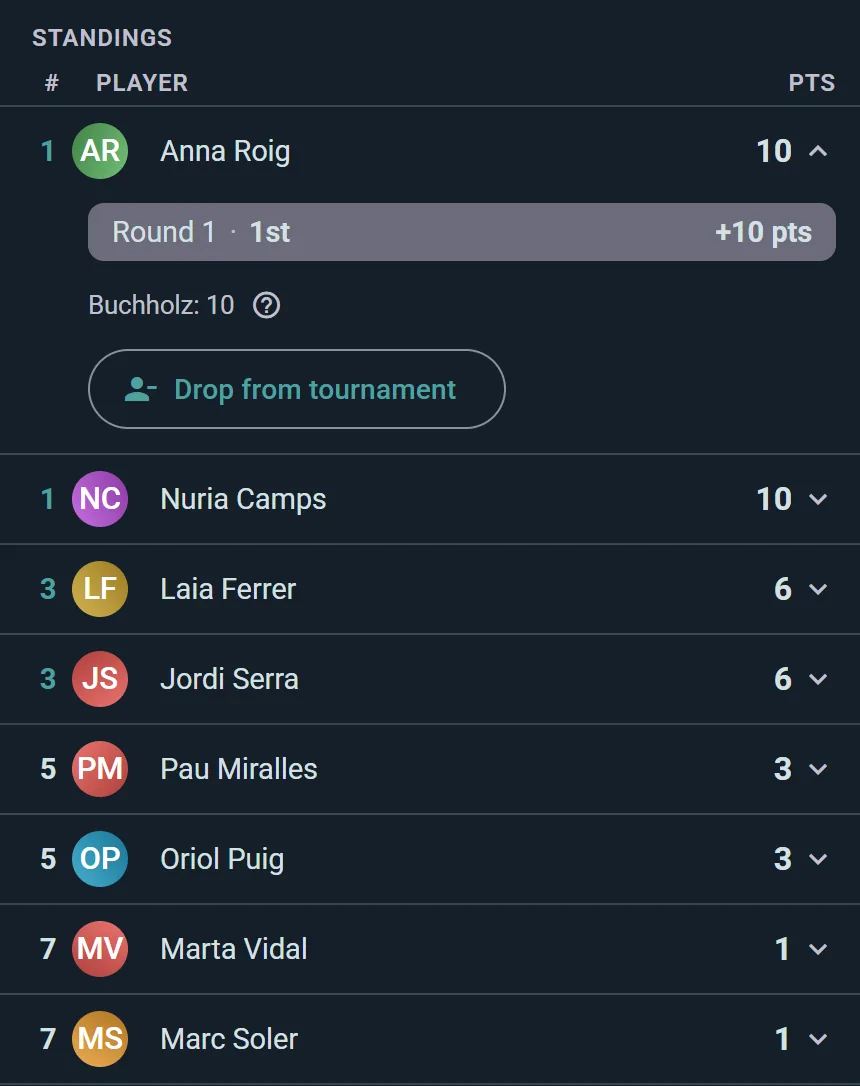
Buchholz, head-to-head, shared placements resolved higher or averaged — the rules are set in the config, applied live, and visible to every player on their own phone.
- Real tiebreakers. Buchholz and head-to-head, not “whoever the organizer remembers winning”.
- Shared placements, your policy. A tie at the table awards the higher placement’s points, or the average — your call, made once.
- Results in, table updates. Report a match and every phone in the room already knows.
Results
Every table reports its own result
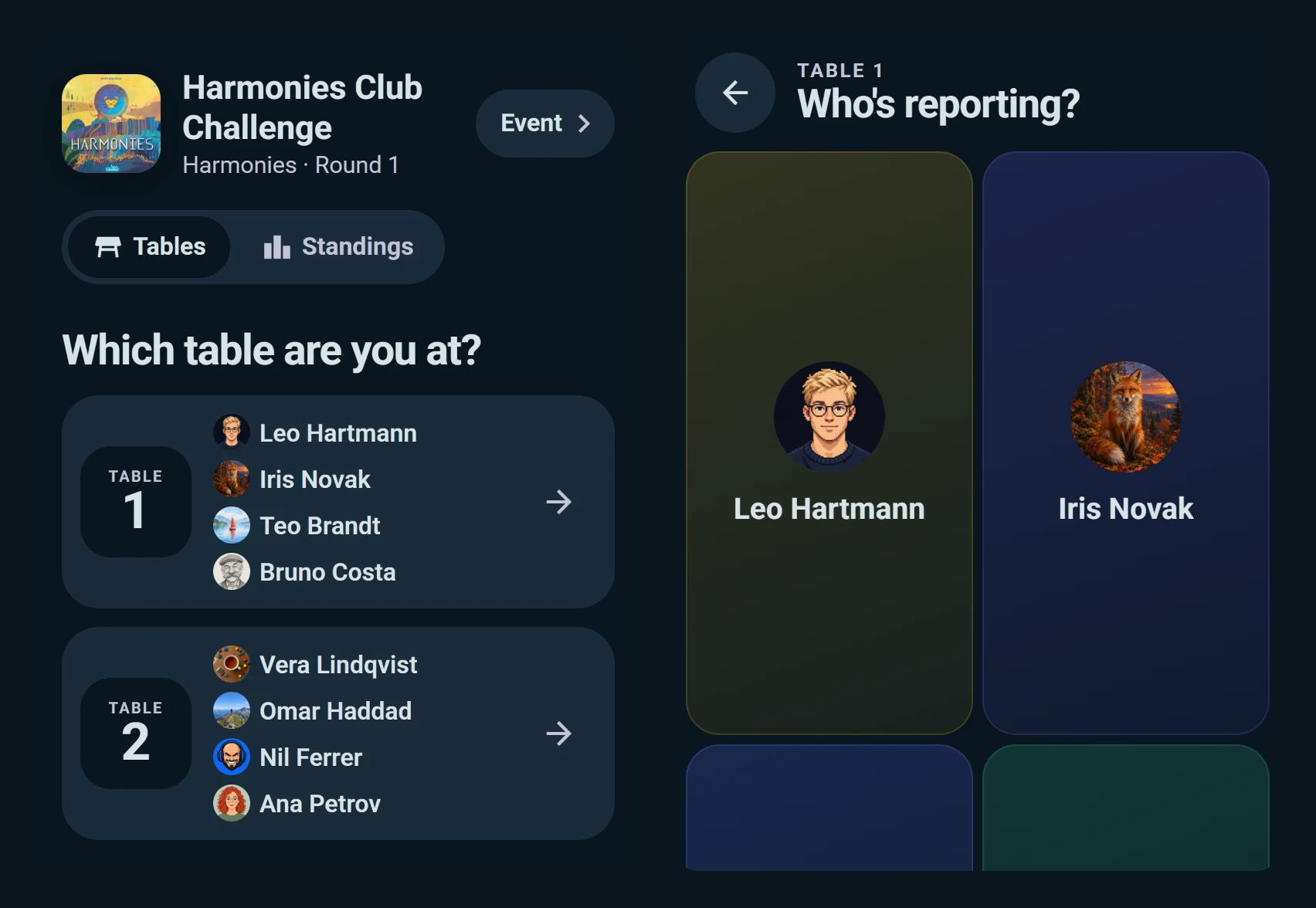
One link, or a QR on each table. Players pick their table, say who they are and type the scores and places. No account, no slips of paper, no queue at the organizer’s laptop.
- The whole table on one sheet. Two phones on the same table see each other’s changes as they happen.
- Correct it until the next round. After that, only the organizer can change a result.
- Standings on the same link. Players follow the room from their seat while the next round is paired.
The details that save the night
Everything else the spreadsheet was failing at
Roster from the event
Attendees are the players — no retyping names into a second tool.
Table sizes that fit the game
Four-player Azul rounds and two-player finals in the same system.
Points your community expects
Placement points, bye points and shared-rank policy, configured per tournament.
Standings on every phone
Players follow the table live instead of queueing at a laptop.
Paid entry, if you want it
The same event sells tickets with Stripe and scans them at the door.
Inside a bigger event
A tournament can run as a sub-event of a convention day, co-hosted and credited.
Guests and pasted lists
Players without an account play as named guests, and a spreadsheet of entries becomes the roster in one paste.
Someone arrived late
Add them and see where they fit before anything moves. Started wrong? Reset back to setup.
The final classification as a PDF
Every place, point and tiebreaker on A4, for the prize table or the federation.
Getting started
From sign-ups to first pairing in minutes
Pick the format
Swiss for a league night, mixer to mix the room, elimination to crown someone — or chain them into phases. Table size, rounds and points come with sensible defaults.
Confirm the pairings
The system proposes round one — or the whole bracket. You review, adjust if the room demands it, confirm.
Report results, hand out the trophy
Results flow into standings, tiebreakers apply themselves, and the last thing left to do by hand is the handshake.
Honestly
Against the spreadsheet and the printed bracket
It worked, until the third round of a busy night. It always breaks in the third round.
| Spreadsheet + printout | Ludoya | |
|---|---|---|
| Pairings each round | Someone’s laptop | One tap |
| Three or four per table | Manual | |
| Tiebreakers | Argued | Buchholz, head-to-head |
| Standings visibility | A pillar | Every phone |
| Bracket | Printed | Live |
| Heats into a final bracket | Two spreadsheets | |
| Sign-ups | A second list | The attendees |
| Paid entry | Cash box | Stripe tickets |
| Results from each table | Slips of paper | Players’ phones |
| Final classification | Retyped | A printable PDF |
What it costs
Tournaments are part of the Club plan — the plan for people running the room rather than sitting in it — alongside raffles, sub-events and Telegram and Discord announcements. Prices are public on the pricing page.
Selling entry to the tournament? Ludoya Tickets charges 3% per sold ticket and nothing else, and ships with the Business plan’s door tools.
Run the tournament. Skip the spreadsheet.
Format, pairings, standings and the bracket — handled. You bring the trophy.
Frequently Asked Questions
Can players report their own results?
Yes. Turn on the table reporting link and print its QR: anyone at a table picks it, says who they are and enters every score and place, with no account. Results count straight away and can be corrected until the next round starts.
Can more than two people play per table?
Yes — that is the point. Swiss and mixer seat three, four or more per table, with placement points per finishing position. Elimination brackets are one-versus-one, as a knockout has to be.
What is a mixer tournament?
Swiss’s sociable cousin: the entire schedule is built up front to maximise how many different people each player meets, instead of sorting the field by strength. Usually the right choice for a club night.
Which tiebreakers are supported?
Head-to-head, Buchholz, raw score sum and first places, applied in the order you configure, plus a shared-placement policy (higher or average points) for ties at a table. All set before round one.
What happens when the player count doesn’t divide evenly?
Someone sits a round out and receives the bye points you configured, so the maths never punishes them. In elimination, byes advance automatically through the bracket.
Do players need to do anything?
Join the event — attendees are the roster. During play they watch the standings and their next table on their own phones.
Can the tournament be part of a bigger event?
Yes — run it as a sub-event of a convention or games day, including co-hosted with another club or a publisher, properly credited on both sides.
Can we charge entry?
Yes — the same event sells tickets through Stripe (3% per sold ticket, nothing else) and verifies them by QR at the door.
Which plan do we need?
The Club plan covers tournaments in all four formats. Paid entry and the professional door tools come with Business. Both are priced publicly on the pricing page.