
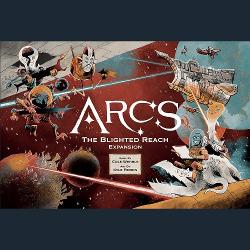
2024 · Expansion for Base-game
Arcs: The Blighted Reach Expansion
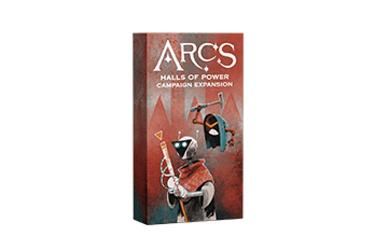
Adds a linked micro-campaign structure in which each session is an episode of a three-part saga across a broader galaxy. Players start as minor regents in a decaying empire and follow branching fate seeds that change future games based on completed objectives and major decisions. Events such as world destruction, refugee flows, or societal collapse carry consequences into subsequent episodes, and players can shift from ruling a homeworld to operating from a lone flagship. The campaign includes multiple branching fate paths to uncover lost knowledge, migrate populations, or build alliances. Individual episodes run under two hours, allowing play as single skirmishes or as a consecutive three-act campaign.
- Players
- 2–4 best 4
- Complexity
- 4.5 / 5
About the game
- Design
- Art
- Publisher



Expansion for
See them in Ludoya
Expansions
See them in Ludoya
Where to buy it
Shop prices and second-hand copies, checked every day.
On Ludoya's tables
Full stats in Ludoya- 36
- Plays logged
- 38
- Players
- 3h 36m
- Average play
- 52
- In collections
- 7
- On wishlists
- 3
- Pre-ordered
9.0/10
from 6 Ludoya reviews
andycted9.1 One 4p and one 2p campaign. A tough game to master due to the many interlocking dynamics, rules, laws, fates and heavy interaction. Surely needs some dedication, but the end result can be unique. Interaction lovers and those who don't mind player balancing, this is one of the richest approachable games you can find. (Previous comment) After a single 2p campaign, promises to use Arcs excellent base mechanics to create a more strategic gameplay and story. The result is close to perfect, the games suffers a bit from learning and managing quite a bit of chrome, though . Compared to a semi-abstract space wargame like base Arcs, this is a semi-abstract space opera.
It is more complicated than regular Arcs and feels too much ameritrash for my taste. You can totally ruin the campaign just by random moments and it feels somehow wrong
Impresionante campaña. No sé le puede pedir más a un juego.


Rules questions
Answered from the rulebook by Ludoya's rules assistant.
How do my objective marker and objectives actually move and score — when do I complete an objective or win with a final objective?
Your objective marker starts on the space shown on your objective card and moves down the Power track when your Fate or other effects tell you to advance it; you complete an objective when it reaches 0 (Act I–II) (p. 8). In Act III some Fates give grand ambitions that score Power at chapter end (p. 9), and a “C” Fate final objective wins immediately at the end of a chapter if your objective marker is at 0 and you have ≥1 Power (p. 9).
I played an Event card — who calls the Summit and what happens when we resolve the Event?
At the end of the round in which any Event cards were played, the player with initiative may call the Summit, then that player rolls the event and number dice and resolves the event die (Crises or Edicts); if the Imperial Council was secured the same round, resolve the Council instead and do not resolve the Event (p. 12–13).
How do Catapult moves work and what stops them — do Blight or gate control end Catapult moves?
Catapult moves are taken typically from Loyal starports and follow the Movement Law that Imperial ships only move when moved along with Loyal ships (p. 10); catapult sequences can drop ships off along the way (p. 11). Catapult moves must end if you move into a gate with fresh or damaged Blight (p. 19), and various gate-control rules (Empire/Regent/Outlaw control) also end Catapult moves for particular factions as specified on page 10.
What is the Truce Law — can a Regent attack or tax another Regent when Imperial ships are present?
The Truce Law means Imperial ships protect Regents from harming and taxing each other, so Regents cannot harm or tax Rival Regents in systems that have Imperial ships (p. 11). When attacking or defending with Regents, Imperial ships are added to the battle as described, and Outlaws must destroy all defending ships (including Imperials) to hit a Regent’s buildings (p. 11).
I got a Flagship — can I still build cities/starports on the map and how do Flagship hits/upgrades work?
When you get a Flagship you replace your Loyal buildings on the map with Free buildings and you may no longer build Loyal cities or starports on the map; instead you build Upgrades and Armor on your Flagship board (p. 22). Upgrades and Armor grant benefits and add dice when fresh starports exist (p. 23), and in combat Upgrades/Armor are hit like ships when attacking but like buildings when defending, with Armor always taking hits before its matched Upgrade (p. 23–24).
What exactly happens during the Intermission between Acts — what gets repaired, destroyed, and how does initiative/Power change?
During Intermission you resolve Fate effects, return Court cards/agents, return trophies and frozen resources, repair all damaged Blight, then destroy all damaged ships, buildings, and Flagship Upgrades/Armor and destroy buildings in systems that have Blight and no ships (p. 28). After that give initiative to the player with the most Power and every player with more than 1 Power loses half their Power (round to lose less), and then players who completed or failed objectives choose or draw new Fates per the steps (p. 29).
Free, on web, Android and iOS
Play Arcs: The Blighted Reach Expansion with Ludoya
- Keep it in your collectionTrack your copy and its expansions, lend it to friends, or put it on your wishlist and get told when the price drops.Add it to your collection
- Log every playScores, winners, timers and photos, then your stats: win rate, favourite player count, best score.Log a play
- Settle rules questionsAsk anything about the rules and get an answer from the rulebook, with the page to check it on.Ask the rules assistant
- Find people to play it withClubs, game nights and events near you that bring this game to the table.See events
Game facts (players, playing time, age, credits) from BoardGameGeek.