
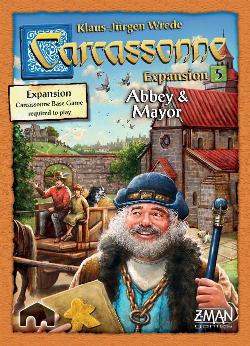
2007 · Expansion for Base-game
Carcassonne: Abbey & Mayor
This expansion adds new wooden pieces, abbey tiles, and landscape tiles to the base game. Abbey tiles act like cloisters but can be placed without matching adjacent edges and immediately complete adjacent features when placed. Mayors are a new city-only follower whose strength equals the number of pennants in the city. Barns allow players to score fields during the game instead of waiting until the end. Wagons are placed on roads, cities, or cloisters and may move to an adjacent open feature when their current feature is completed. Includes tiles and components that integrate with the base game to change scoring and follower placement dynamics.
- Players
- 2–6 best 3
- Playing time
- 30 min
- Age
- 8+
- Complexity
- 2 / 5




Where to buy it
Shop prices and second-hand copies, checked every day.
On Ludoya's tables
Full stats in Ludoya- 30
- Plays logged
- 10
- Players
- 101
- In collections
- 2
- On wishlists
- 1
- Pre-ordered
7.6/10
from 24 Ludoya reviews
Rules questions
Answered from the rulebook by Ludoya's rules assistant.
Do I have to draw a land tile to place an Abbey, and where can I put it?
Instead of drawing and placing a Land tile, you may place your Abbey tile; it may only be placed in an empty space surrounded on its four orthogonally adjacent sides (i.e., to fill a 1-tile hole), and you may not place it if no such hole exists (page 2).
Can I put a meeple on the Abbey and how is it scored?
Yes — you may place a meeple as a monk on the Abbey; the Abbey behaves like a monastery, completes the sides of adjacent tiles, and is scored identically to a monastery (score any features completed by its placement) (page 2).
How does the Mayor work — how is his strength calculated and who scores the city?
A mayor's strength equals the number of coats of arms (shields) in the city it occupies (normal meeple=1, large meeple=2); when scoring a completed city each player's total strength is added and the highest-strength player(s) score the points (ties all score full); a mayor in a city with no coats of arms has 0 strength (page 3).
Where exactly can I place a Barn, and can I place it where farmers already are?
You may place a barn on the junction where four tiles meet only if the corner of each of those four tiles depicts field (i.e., a pure 4‑tile field junction); you may place a barn on a field already occupied by farmers but not on a field already occupied by another barn, and a placed barn remains in play until the game end (pages 3–4).
What happens to farmers when I place a Barn or when a field is connected to a Barn, and how are barns scored at game end?
If you place a barn into a field with farmers that field is scored immediately as at game end (the player with most farmers scores 3 points per completed city) and those farmers are returned; if a tile connects a farmer-occupied field to a barn-occupied field that connected field is scored that turn for 1 point per completed city and farmers are returned; at game end each barn scores 4 points per completed city in its field (pages 4–5).
Can I place a Wagon in a field and how does Wagon movement work after scoring?
A wagon may not be placed in a field but may be placed on roads, cities, monasteries/abbeys like a normal meeple; when its feature is scored it scores like a normal meeple and then you may either return the wagon to your supply or move it to a directly adjacent unoccupied, incomplete feature (same tile or orthogonally/diagonally adjacent); if no such move exists the wagon must be returned (page 5).
Free, on web, Android and iOS
Play Carcassonne: Abbey & Mayor with Ludoya
- Keep it in your collectionTrack your copy and its expansions, lend it to friends, or put it on your wishlist and get told when the price drops.Add it to your collection
- Log every playScores, winners, timers and photos, then your stats: win rate, favourite player count, best score.Log a play
- Settle rules questionsAsk anything about the rules and get an answer from the rulebook, with the page to check it on.Ask the rules assistant
- Find people to play it withClubs, game nights and events near you that bring this game to the table.See events
Game facts (players, playing time, age, credits) from BoardGameGeek.