
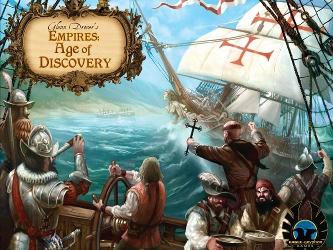
2015 · Civilization
Empires: Age of Discovery
Set in the 16th-century Age of Exploration, players act as competing European powers building colonies and trade networks in the New World. Over three ages, players send expeditions, grow a merchant fleet and military, train workers, and construct buildings that grant nation-specific bonuses. Economic development, resource management, and military actions interact as players vie to expand their empire farther than opponents.
- Players
- 2–6 best 5
- Playing time
- 50–150 min
- Age
- 10+
- Complexity
- 3.3 / 5
About the game
- Design
- Publisher




Expansions
See them in Ludoya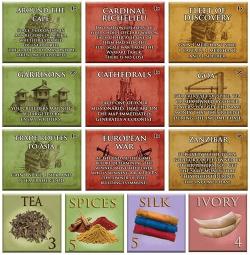 Empires: Age of Discovery – World Variant Components2015
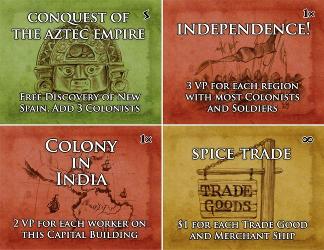 Empires: Age of Discovery – Bonus Capital Buildings2015
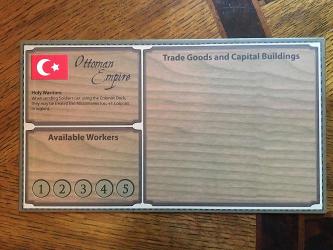 Empires: Age of Discovery – Ottoman Player Board and Gold Figures2015
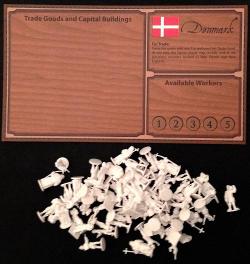 Empires: Age of Discovery – Denmark Player Board and White Figures2015
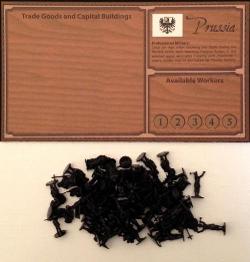 Empires: Age of Discovery – Prussia Player Board and Black Figures2015
On Ludoya's tables
Full stats in Ludoya- 39
- Plays logged
- 46
- Players
- 3h 14m
- Average play
- 6
- In collections
- 11
- On wishlists
6.2/10
from 9 Ludoya reviews
Evan5.9 Worker Placement and area control fused. Players lay their pawns into action spaces on the big table to the right, and then when everyone is done the board is resolved from top to bottom, left to right. One element of the game that initially really excited me was that there are actions that, for the cost of a worker this round give you a worker for the next round that has some special ability or function for one or two specific action spaces. I tend to like games where not all workers are treated equally. The game starts out where everything seems possible, and then you realize as the colonist dock fills up, and as people grab the trade goods, and as the player ahead of you in turn order drops his captain in the merchant ship box, that you'll have to do better to get what you want. The game includes rules for the players to have variable player powers that are really strong, and really detract from the generally enjoyable core experience of the game. Many of the powers have strong unmitigatable take-that effects. Thankfully playing with them is optional. It doesn't help that this game has one or two really frustrating building tiles that can be built that tend to warp games in similar ways every time they come out. In particular, the building that lets you force trade good swaps, effectively giving you lots of money and one or more players no money; and yet it's rare the player who spends the resources to take this wins. Component wise, the building tiles can be a little difficult as they have text but often require looking up their full use in the rulebook. The meeples are plastic and dinky. Prone to falling over, and hard to tell apart from each other. Overall, the game isn't bad, but the luck is a little high, the components aren't wonderful, and it's similar enough to Dominant Species that I'd rather be playing that game. It has none of these little issues, but a similar feel, and is generally more enjoyable, if harsher. ★ Art, Iconography and components functional ★ Clever or interesting mechanisms ★ Reasonably low downtime between turns with mildly AP players ★ Multiple plays stay interesting ★ Low or mitigatable luck elements ★★☆☆☆ Raw enjoyment
Similar games

People who own it also own

Free, on web, Android and iOS
Play Empires: Age of Discovery with Ludoya
- Keep it in your collectionTrack your copy and its expansions, lend it to friends, or put it on your wishlist and get told when the price drops.Add it to your collection
- Log every playScores, winners, timers and photos, then your stats: win rate, favourite player count, best score.Log a play
- Score it without paperUse the community's score sheets and play helpers, and let Ludoya add up the points.Find score sheets
- Find people to play it withClubs, game nights and events near you that bring this game to the table.See events
Game facts (players, playing time, age, credits) from BoardGameGeek.