
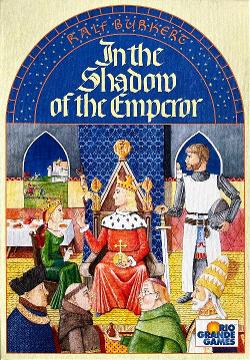
2004 · Political
In the Shadow of the Emperor
Players represent aristocratic families at the imperial court, using limited action cards to maneuver family members into Elector States and other positions of influence. Each Elector State grants voting power and a special ability; players displace opponents, age and lose family members, and manage a tight hand of actions to seize control of key regions. As influence grows, players collect victory points; the game ends after a set number of rounds and the player with the most points wins.
- Players
- 2–4 best 4
- Playing time
- 90 min
- Age
- 12+
- Complexity
- 3.3 / 5
About the game
- Design


On Ludoya's tables
Full stats in Ludoya- 15
- Plays logged
- 22
- Players
- 2h 1m
- Average play
- 16
- In collections
- 2
- On wishlists
5.0/10
from 6 Ludoya reviews
Evan4.6 This is an area control game with a lot of really interesting mechanisms hampered by some really poor graphic design choices. It's essentially a worker placement game, but since I think it came out before worker placement games were really a thing, actions are resolved by taking cards from a display, and then returning the cards at the end of the round during the reset phase. The board is divided into different regions, each with limited spaces, and whoever controls the majority of those spaces gets to promote one of their markers to the ruler spot. The ruler spot comes with a special ability, and the ability to vote for which player will be the overall king, who gets to go first, break ties and gets a few extra points. As the rounds progress, everyone's control markers age by rotating the markers to the side with the next highest number. When guys get too old, they fall off the board, which means who controls what tends to be fluid. Not only that, but the game doesn't give you VP for holding positions for multiple rounds, only for taking new positions. There's a little more to things in that it matters what color of action cards you take, and the push your luck for who gets to try to be elected to the kingship each round, and the fragility of the fact that players vote for the current king or the person who cut their turn short to grab the challenger card, which could mean you've weakened your position to get nothing if your opponents don't side with you. The look of the game is really rough. The colors of the board are among the ugliest I've ever seen. The game also doesn't really work without exactly four players. If there was ever a game that would be a challenge to get to the table with any regularity it's this one. In addition to that, the game is only five rounds, but the rounds are long since there's so much jockeying for position and calculating and recalculating. There are a few elements that are important but hard to remember, for example, there's a ruler ability that lets the player drop an old guy marker into a region for just that turn, so if you were looking to barely squeak control of a space from someone with that ability and you forgot they were in charge of that particular kingdom, it can come across as a game crushing gotcha. I really do love clever and different area majority games, but I think this game in it's current form is just not for me. I think I would really adore this game if it got a nice second edition treatment of some kind. ★ Art, Iconography and components functional ★ Clever or interesting mechanisms ★ Reasonably low downtime between turns with mildly AP players ☆ Multiple plays stay interesting ★ Low or mitigatable luck elements ★★★☆☆ Raw enjoyment
Tom4.6 Only with four! And even then, while the theme is neat, the game seems to kind of go on autoplilot when playing.





Free, on web, Android and iOS
Play In the Shadow of the Emperor with Ludoya
- Keep it in your collectionTrack your copy and its expansions, lend it to friends, or put it on your wishlist and get told when the price drops.Add it to your collection
- Log every playScores, winners, timers and photos, then your stats: win rate, favourite player count, best score.Log a play
- Score it without paperUse the community's score sheets and play helpers, and let Ludoya add up the points.Find score sheets
- Find people to play it withClubs, game nights and events near you that bring this game to the table.See events
Game facts (players, playing time, age, credits) from BoardGameGeek.