
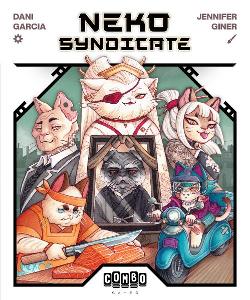
2024 · Animals
Neko Syndicate
Players lead rival feline clans vying to become the next Kumichō by controlling sushi production and distribution across the city of Mininogata. Each turn players build and traverse a pyramidal tableau of cards that represents a district and their chain of command; that tableau serves as both the action selection tree and the source of objectives. Players use it to cook sushi, move deliveries into different zones, and complete missions assigned by the current leader. Play runs for a fixed number of turns with simultaneous play and low player interaction, rewarding efficient tableau construction and speed in fulfilling missions to score prestige points.
- Players
- 1–4 best 2
- Playing time
- 20–40 min
- Age
- 14+
- Complexity
- 2.7 / 5
About the game
- Design
- Publisher


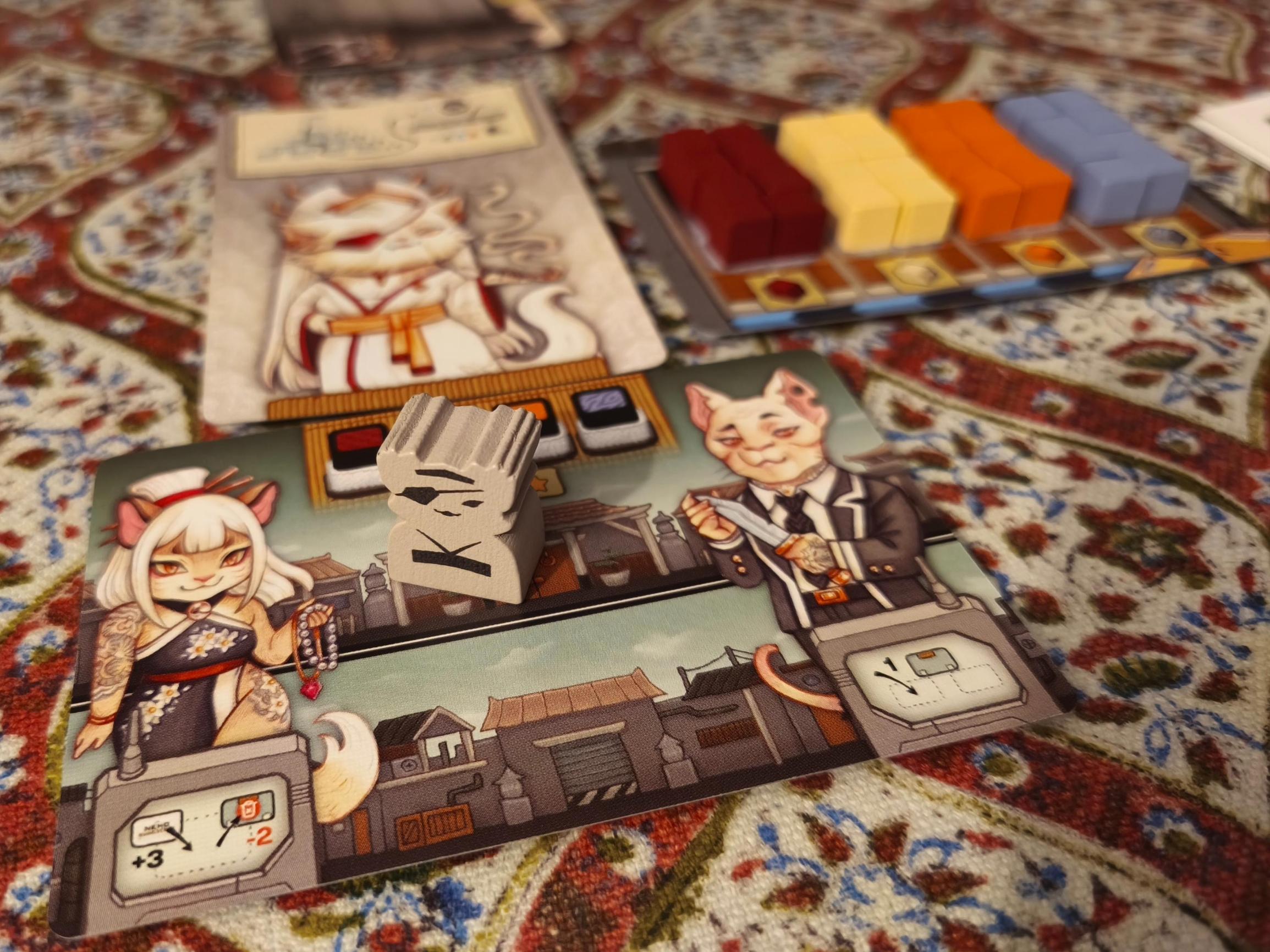
Photos from Ludoya tables
All photos in Ludoya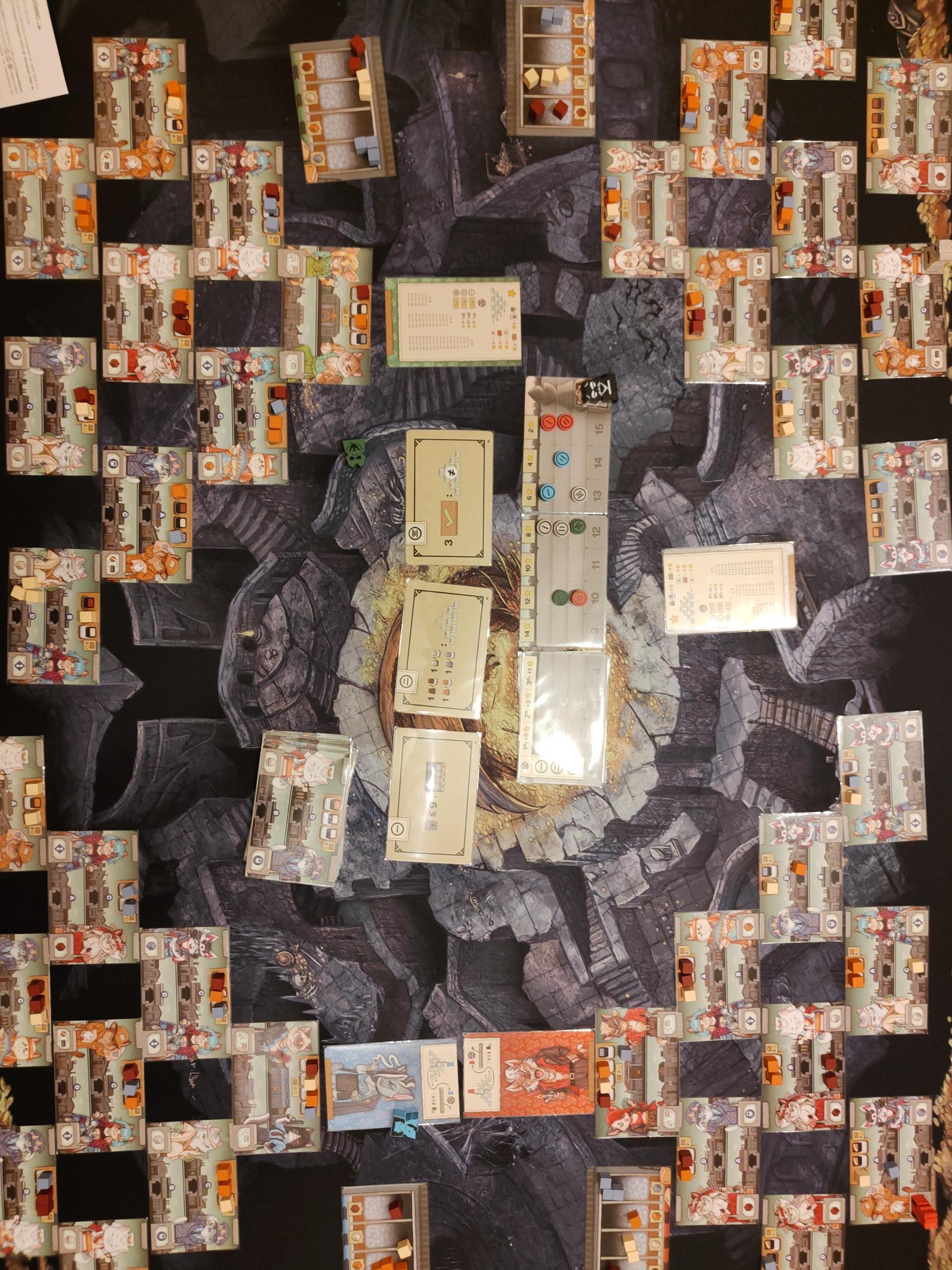
Where to buy it
Shop prices and second-hand copies, checked every day.
On Ludoya's tables
Full stats in Ludoya- 219
- Plays logged
- 182
- Players
- 45m 48s
- Average play
- 76
- In collections
- 3
- On wishlists
- 1
- Pre-ordered
7.1/10
from 35 Ludoya reviews
Kaskagues6.5 A pretty easy to learn multi-solitaire game where you race to be the next sushi boss. Overall is a nice filler that I'd play but personally wouldn't propose it. Art: The art is pretty and the theme is endearing. Player interaction: The only player interaction is who completes each mission first. I wish it had more interaction. For example, having a district shop that is public to all players, although good luck analyzing other players pyramids. Gameplay: The action types are interesting but if you want to play it optimally the metro line tends to make the game prone to analysis paralysis. Cards also come randomly and trying to wait for a good card before placing it will hinder your actions per turn, so often you must place the card you got. Meta: I haven't played enough but the meta will probably involve prioritizing completing the missions while counting the amount of sushi types so you are capable of delivering to all areas and checking the metro lines for the end game "fill all deliveries" which will burn your brain.

Rules questions
Answered from the rulebook by Ludoya's rules assistant.
Do I have to move my leader down one of the two boxes below each time during the Command phase, or can I jump around the pyramid?
You must start on one of the two action boxes on your lieutenants card and after activating an action you always move your leader to one of the two boxes on the card immediately below the box you are on, repeating until there is no card below (so no jumping to non-adjacent boxes). (p.5)
How many times can I activate a given action when my leader passes through it?
An action may be activated up to a number of times equal to the level that action occupies in your pyramidal structure (lieutenants=Level 1, lowest possible level=Level 4), e.g., an action on Level 3 can be used up to 3 times during your walk. (p.5)
If I use the Chief Operations Officer to place a minion card from my Waiting Room, can I use that new card's actions the same turn?
Yes — placing a minion with the COO adds it into your pyramid and, since the Command phase continues descending the chain of command, you may then choose to activate that card's actions (they are optional) as you pass through them. (p.7)
What's the exact difference between delivering sashimi and delivering nigiri — does a cube in the top neighborhood automatically complete nigiri?
Sashimi is fulfilled automatically whenever a matching cube is in a top neighborhood and a sashimi slot exists, but nigiri require performing the Cook action to combine rice with a cube before they count as delivered. (p.8–9)
How do Delivery lady and Subway operator movements work — do subway moves need matching neighborhood letters?
The Delivery lady moves non-delivered cubes vertically between adjacent neighborhoods (up or down one step) up to the action's level, while the Subway operator moves a non-delivered cube to any neighborhood that has a subway station on the same line letter as the cube's current neighborhood, also up to the action's level. (p.8–9)
How is final scoring calculated for the pyramid and missions?
For the pyramid you total the prestige modifiers on each level (deliveries, completed-card bonuses, penalties for loose cubes, missing or empty cards) then multiply each level by its multiplier (Level 1 x4, Level 2 x3, Level 3 x2, Level 4 x1); mission points come from your scoring markers on the Kumichō path plus position bonuses (5/3/1/0) for each mission. (p.10, p.12)


















Free, on web, Android and iOS
Play Neko Syndicate with Ludoya
- Keep it in your collectionTrack your copy and its expansions, lend it to friends, or put it on your wishlist and get told when the price drops.Add it to your collection
- Log every playScores, winners, timers and photos, then your stats: win rate, favourite player count, best score.Log a play
- Settle rules questionsAsk anything about the rules and get an answer from the rulebook, with the page to check it on.Ask the rules assistant
- Find people to play it withClubs, game nights and events near you that bring this game to the table.See events
Game facts (players, playing time, age, credits) from BoardGameGeek.