
2019 · Animals
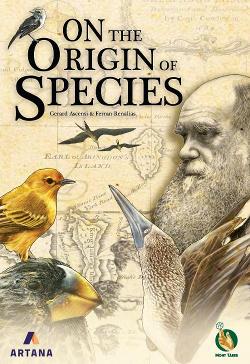
On the Origin of Species
Players accompany Charles Darwin on the Beagle voyage through the Galapagos, researching habitats and cataloguing species. On each turn a player chooses between Research—placing research tokens on different species tiles to gain air, land, or water knowledge—or Discover—using habitat knowledge to place new species tiles, score points, and gain evolution, character, and object cards while advancing the Beagle. The game ends when the Beagle completes its voyage; players add endgame evolution points from a final goal card to their accumulated points. Highest score on the track wins.
- Players
- 2–4 best 3
- Playing time
- 45–80 min
- Age
- 9+
- Complexity
- 2.3 / 5
About the game
- Art
- Publisher



Where to buy it
Shop prices and second-hand copies, checked every day.
On Ludoya's tables
Full stats in Ludoya- 53
- Plays logged
- 61
- Players
- 54m 16s
- Average play
- 26
- In collections
- 4
- On wishlists
3.6/10
from 14 Ludoya reviews
Garfield2.0 I didn't feel the theme. And I didn't like the mechanism placing cube for purchasing animal tiles. It happens a lot that others are purchasing the tile you wanted and then you have to rearrange your cubes. Too repetitive. [c] Theme: ★★☆☆☆ <!-- size 7]Very little --> Gameplay: ★★☆☆☆ <!-- size 7]Too repetitive --> Interaction: ★★★☆☆ <!-- size 7]Race for the animal tiles --> Artwork: ★★★★☆ <!-- size 7]Nice --> Luck: ★★★☆☆ <!-- size 7]Random cards --> Strategy: ★☆☆☆☆ <!-- size 7]Very little --> Components: ★★★☆☆ <!-- size 7]Ok, nothing special --> Play duration: ★★★★☆ <!-- size 7]Good --> Easy to teach: ★★★★☆ <!-- size 7]Quite easy (15min) --> Rules quality: <!-- size 7]not read --> Setup time: ★★★★☆ <!-- size 7]Fast --> No downtime: ★★★★☆ <!-- size 7]Almost no downtime --> Replay value: ★★☆☆☆ <!-- size 7]Random animal tiles --> [/c]
Evan2.5 In this game either you place a cube onto two tiles in the grid, or you pull cubes from tiles in the grid, treating those tiles as if they were the resources according to what is printed on the tile, to buy a new tile and add it to the grid. This act additionally scores you some points and draws you some special cards. Rather than simply adding a new tile, you can replace an existing one with the higher level, then claim the lower level one into your own personal score pile, where depending on the game mode you are playing, it can be work some significant points. The tricky part of the game, the part that's really interesting, is that for the most part, resource cubes used to pay for tiles, need to come from tiles on or around the space you are putting the new tile into. This puzzle of deciding what tile to buy and where to save your resources up makes for a game with some real potential. Unfortunately, the potential never comes to fruition. The game is full of powerful one time use cards that swing and warp the game state. The cards aren't evenly useful, some of the cards are drafted from a faceup display, but others are pulled from facedown piles. In a game that is asking you to plan ahead your turns by carefully watching where your opponent's resources are being placed, to the degree that is needed here, you don't want someone to swing in with secret resources from their hand that you couldn't plan or account for. With a little more work, this game could have been something special, so it's a pity that it wound up angling too far to the lighter end of things. ★ Art, Iconography and components functional ★ Clever or interesting mechanisms ★ Reasonably low downtime between turns with mildly AP players ☆ Multiple plays stay interesting ☆ Low or mitigatable luck elements ★☆☆☆☆ Raw enjoyment


People who own it also own




Free, on web, Android and iOS
Play On the Origin of Species with Ludoya
- Keep it in your collectionTrack your copy and its expansions, lend it to friends, or put it on your wishlist and get told when the price drops.Add it to your collection
- Log every playScores, winners, timers and photos, then your stats: win rate, favourite player count, best score.Log a play
- Score it without paperUse the community's score sheets and play helpers, and let Ludoya add up the points.Find score sheets
- Find people to play it withClubs, game nights and events near you that bring this game to the table.See events
Game facts (players, playing time, age, credits) from BoardGameGeek.