
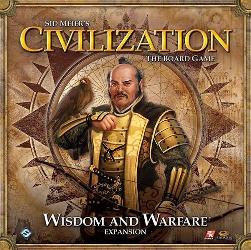
2013 · Expansion for Base-game
Sid Meier's Civilization: The Board Game – Wisdom and Warfare
Adds six new civilizations, new technologies, relics, wonders, and culture cards to expand the core game. Introduces an alternative combat system where units have separate Strength and Health values; battles track wounds and compare remaining health plus bonuses, so partial damage affects future turns. Adds a new city action, Starting a Building Program, to modify city production, and a Social Policies system that lets civilizations adopt options like Rationalism or Organized Religion to shape long-term strategy.
- Players
- 2–4 best 4
- Playing time
- 180 min
- Age
- 14+
- Complexity
- 4 / 5
About the game


Expansion for
See them in Ludoya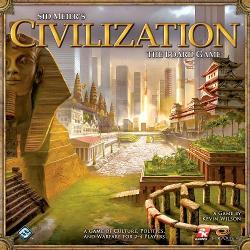
On Ludoya's tables
Full stats in Ludoya- 16
- Plays logged
- 18
- Players
- 3h 50m
- Average play
- 26
- In collections
8.0/10
from 4 Ludoya reviews
Sup7.8 Sleeved
Rules questions
Answered from the rulebook by Ludoya's rules assistant.
How does the new “Start a building program” city action work — does it permanently double my city’s production?
You place a building program marker on the city; the next time that city is used to produce a figure/unit/building/wonder the marker is discarded and the city’s outskirts production is doubled for that single produce action only (it does not double production from other sources and any excess is wasted). (p.7)
When I win a battle, how does looting work and when do I spend loot?
If the loser had figures the winner gains 1 loot (2 loot if the loser was defending a non-capital city; capturing a capital is an immediate military victory), and the winner immediately spends the loot to purchase effects from the loot table, buying as many effects as their loot allows (they may buy the same effect multiple times). (p.6)
On replacement unit cards, what do Strength and Health mean and how are wounds resolved?
Strength is the wounds a unit deals when it attacks and health is how many wounds it can take before being killed; killed units are returned faceup to the bottom of their original unit deck, and after both players finish playing battle forces you total surviving units’ health minus wounds plus any combat bonus to determine the battle winner (ties favor the defender). (pp.8–9)
Can I play a unit onto a battle front that already has two engaged units?
No — units cannot attack an existing front that already has two units engaged on it; if all available fronts are fully engaged you must start a new front. (p.8)
How do social policies work — how many can I have and when do I adopt or lose them?
Your social policy maximum equals your number of built cities (each civilization starts with a maximum of 1, except the French who start at 2); whenever your maximum increases you must immediately adopt a new social policy, and whenever it decreases you must return one adopted policy to the unused pile (switching policies is normally not allowed except via specific effects). (p.10)
What happens when I discover a city-state or a relic from a hut/village?
Finding a city-state places a city-state marker on that square; you control it while you have a figure there and it counts as outskirts of your capital, granting small recurring bonuses, while relics place a relic marker that prevents building/altering the square until an army ends movement there to remove the marker and immediately grant the relic’s one-time effect (e.g., Ark = two culture advances; Attila’s Village = two free unlocked units). (pp.9,11–12)
Free, on web, Android and iOS
Play Sid Meier's Civilization: The Board Game – Wisdom and Warfare with Ludoya
- Keep it in your collectionTrack your copy and its expansions, lend it to friends, or put it on your wishlist and get told when the price drops.Add it to your collection
- Log every playScores, winners, timers and photos, then your stats: win rate, favourite player count, best score.Log a play
- Settle rules questionsAsk anything about the rules and get an answer from the rulebook, with the page to check it on.Ask the rules assistant
- Find people to play it withClubs, game nights and events near you that bring this game to the table.See events
Game facts (players, playing time, age, credits) from BoardGameGeek.