
2012 · Economic
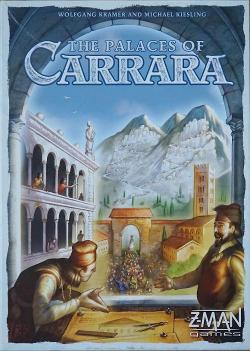
The Palaces of Carrara
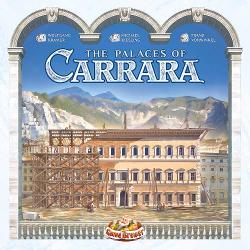
Players buy marble from a shared market and use it to construct buildings in a 19th-century Italian region. Each turn players acquire marble, hire craftsmen, or invest in building projects, balancing the immediate cost of raw material against the future value of completed structures. Actions affect market prices and benefit opponents, so timing and market manipulation matter. The game offers beginner and advanced setups to introduce mechanics gradually, with players scoring points for completed buildings and certain investments before the game ends.
- Players
- 2–4 best 4
- Playing time
- 60 min
- Age
- 10+
- Complexity
- 2.6 / 5
About the game
- Publisher



Where to buy it
Shop prices and second-hand copies, checked every day.
On Ludoya's tables
Full stats in Ludoya- 137
- Plays logged
- 120
- Players
- 56m 42s
- Average play
- 13
- In collections
- 7
- On wishlists
6.5/10
from 20 Ludoya reviews
Garfield4.0 Nah, nothing special. I guess this game has a 'rich get richer' problem. As soon as one player gets the more valuable stones he can build on the more lucrative spots and therefor get more money/points and can buy more stone than others... Buildings are hard to distinguish when they have the same background color. I liked the rondel with the stones on it. [c] Theme: ★★★☆☆ <!-- size 7]Ok --> Gameplay: ★★☆☆☆ <!-- size 7]Buy stones to build buildings, that's pretty much it --> Interaction: ★★★☆☆ <!-- size 7]Just that others are scoring what you wanted and take the stones you wanted --> Artwork: ★★☆☆☆ <!-- size 7]Nothing special --> Luck: ★★★☆☆ <!-- size 7]Random stones drawing --> Strategy: ★★☆☆☆ <!-- size 7]Obvious ones --> Components: ★★☆☆☆ <!-- size 7]Nothing special --> Play duration: ★★★★★ <!-- size 7]Perfect --> Easy to teach: ★★★★☆ <!-- size 7]Quite easy --> Rules quality: <!-- size 7]Not read --> Setup time: ★★★★☆ <!-- size 7]Not much to setup --> No downtime: ★★★★☆ <!-- size 7]Almost no downtime --> Replay value: ★☆☆☆☆ <!-- size 7]Not much I can think of --> [/c]
Evan10.0 Very smooth mechanisms and quick turns. In this game, colored bricks are placed on a rotating wheel. The position and color of the bricks on the wheel dictates the cost of the bricks. Whenever a player buys bricks, the wheel rotates and refills on the next player's turn, which refreshes the selection, but also makes the unpurchased bricks less expensive. With a build action, you discard a number of bricks that match the cost of a building tile, but the color of bricks you use determines which city you are allowed to build in, and they al have different rewards when scoring. The game ends when a player has completed a certain number of the faceup goals, as opposed to a hard timer. Since scoring is an action you have to actually take and not something that just happens to you, the tension stays high and exciting. ★ Art, Iconography and components functional ★ Clever or interesting mechanisms ★ Reasonably low downtime between turns with mildly AP players ★ Multiple plays stay interesting ★ Low or mitigatable luck elements ★★★★★ Raw enjoyment
Sergio Fdez.7.7 Es un juego muy redondo que consigue combinar condiciones muchas veces contrarias. Sencillez con profundidad. Un diseño y unos materiales buenos con un precio aceptable. Es un juego que su tamaño, sus distintos niveles de complejidad y su ilustraciones tan agradables le conceden un grado máximo de versatilidad. Ha sido una grata sorpresa disfrutar de este Kramer. http://mesasdejuegos.blogspot.com.es/2013/09/los-palacios-de-carrara-diseno-italiano.html

Rules questions
Answered from the rulebook by Ludoya's rules assistant.
When I take the “Buy blocks” action, do I have to rotate the wheel first or can I buy from the current sections?
You must rotate the wheel one section clockwise before drawing blocks and then buy from a single section (the wheel is refilled to 11 after rotation) (p.4–5).
Can I pay for a building with mixed-color blocks, and how does that affect which city I can build in?
Yes — you may use blocks of different colors to pay, but the city you build in must accept the colors you used; cities accept progressively more colors from Livorno (white only) up to Lérici (any) as listed on the player board (p.6–7).
If I rotate the wheel and can't afford any blocks, do I just pass my turn?
If, after rotating, you cannot buy any blocks (not enough coins or no free blocks), you must raise your screen, take 2 coins from the bank, and your turn ends — you may not buy afterward (p.5).
How do I calculate coins/VPs and objects when I score a building type?
Choose an unscored building type and score all your buildings of that type: for each building multiply its cost by the value of the city it occupies to get coins or VPs, take one object per scored building, and place your scoring marker on that type (p.8).
How do I score a city and what are the conditions to do so?
A city can be scored only if it has not yet been scored and you have the required number of buildings there (2 for Livorno/Pisa/Lucca; 3 for Viareggio/Massa/Lérici); add the costs of your buildings in that city, multiply by the city's value for coins/VPs, take one object per building, and place your marker on the city (p.9).
Can I announce the end of the game if I'm not sure I really have the objectives, and what happens if I'm wrong?
You may announce the end only after completing all three objectives and you immediately gain 5 VPs; if you reveal you have not completed them play continues normally and the game ends only once all three objectives have been met or the last building is built (p.10–11).




Free, on web, Android and iOS
Play The Palaces of Carrara with Ludoya
- Keep it in your collectionTrack your copy and its expansions, lend it to friends, or put it on your wishlist and get told when the price drops.Add it to your collection
- Log every playScores, winners, timers and photos, then your stats: win rate, favourite player count, best score.Log a play
- Settle rules questionsAsk anything about the rules and get an answer from the rulebook, with the page to check it on.Ask the rules assistant
- Find people to play it withClubs, game nights and events near you that bring this game to the table.See events
Game facts (players, playing time, age, credits) from BoardGameGeek.