
2023 · Animals
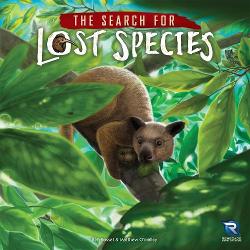
The Search for Lost Species
Players act as scientists leading expeditions to rediscover species that haven’t been seen in decades, focusing on habitats in Indonesia and Papua New Guinea. Gameplay combines deduction and map movement: players gather clues to narrow possible habitats, move across a double-sided island board, and use a special expedition action to search specific locations for a target species. Asymmetric cards add variability to player powers and objectives, and an optional app lets players report sightings to check confirmations. The box includes multiple lost-species targets and scenario variety across two island maps.
- Players
- 1–4 best 2
- Playing time
- 60–75 min
- Age
- 13+
- Complexity
- 3 / 5
About the game
- Publisher




Where to buy it
Shop prices and second-hand copies, checked every day.
On Ludoya's tables
Full stats in Ludoya- 133
- Plays logged
- 70
- Players
- 1h 8m
- Average play
- 31
- In collections
- 28
- On wishlists
- 1
- Pre-ordered
6.8/10
from 6 Ludoya reviews
Kush5.9 I think the Search for Planet X is far superior (and you definitely don't need both). It is more elegant and lets you focus on the core deduction puzzle... that is what one is here for! Species clutters the same game with a bunch of distractions like cards, board movement etc which are not very interesting/ exciting as hundreds of other games have these mechanisms already. I personally like the theme here more, but Planet X wins over all any day!
Rules questions
Answered from the rulebook by Ludoya's rules assistant.
Does a mountain block adjacency — can animals or surveys go “across” a mountain?
No — areas separated by a mountain are not considered adjacent and mountains block placement/adjacency across them (see Rulebook pp8, 24).
What's the difference between Survey by Foot and Survey by Boat — when should I use each and how much time do they take?
Survey by Foot and Survey by Boat are separate actions with different valid target areas and time costs: use Foot for land/adjacent inland areas and Boat for water/coastal routes; each action's rules and time costs are listed with examples (Rulebook p13).
How do camera traps work — do they use an action and what do they reveal?
Setting a camera trap is an action that consumes time and lets you check a specific area for animals per the camera trap procedure; follow the placement and resolution steps on Rulebook pp14–15.
When and how do we place and confirm sighting tokens — can opponents confirm or contest my sighting?
Sighting tokens are handled during the Sighting Phase: players report and place sighting tokens, others may view/confirm them, and then tokens are resolved with correct sightings scored and incorrect ones penalized (see Rulebook pp18–20).
Can the Lost Species be located in an area that has no animals (a truly empty area)?
No — the rules treat 'truly empty' areas specially and the Lost Species will not be placed in an area that is truly empty; consult the Lost Species / truly empty areas rules for details (Rulebook p9).
How does the time track work and how do I advance or activate my Expedition Leader?
Actions move your pawn along the time track according to their time costs; when you reach Expedition Leader spaces you activate or advance your leader as described in the time track and Phase 3 rules (see Rulebook pp10, 16–17).
Similar games
 The Search for Planet X2020
 ArcheOlogic2023
 EXIT: The Game – The Venice Conspiracy2024
 Aqua Garden2021
 The Search for UAPs2024
 EXIT: The Game – The Professor's Last Riddle2022
 Ministry of Lost Things: Case 1 – Lint Condition2025
 Corps of Discovery: A Game Set in the World of Manifest Destiny2025
 Life of the Amazonia2023
 The Light in the Mist2022
 Kronologic: Cuzco 14502025
 AuZtralia2018
People who own it also own
 The Lord of the Rings Adventure Book Game2023
 Suburbia: Collector's Edition2019
 Aeon's End: Legacy of Gravehold2021
 One Night Ultimate Vampire2016
 Dream Home2016The Search for Planet X2020
 Fireball Island: The Curse of Vul-Kar2018
 Galaxy Trucker2007
 Dice Throne: Season Two – Battle Chest2019
 Final Girl2021
 Fort2020
 Hit Z Road2016
Free, on web, Android and iOS
Play The Search for Lost Species with Ludoya
- Keep it in your collectionTrack your copy and its expansions, lend it to friends, or put it on your wishlist and get told when the price drops.Add it to your collection
- Log every playScores, winners, timers and photos, then your stats: win rate, favourite player count, best score.Log a play
- Settle rules questionsAsk anything about the rules and get an answer from the rulebook, with the page to check it on.Ask the rules assistant
- Find people to play it withClubs, game nights and events near you that bring this game to the table.See events
Game facts (players, playing time, age, credits) from BoardGameGeek.