
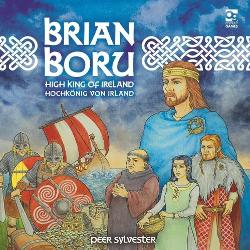
2021 · Card Game
Brian Boru: High King of Ireland
Players compete to unite Ireland by expanding influence through warfare, the Church, and political marriages. The game uses trick-taking as its core mechanic: winning tricks grants influence in towns and helps secure regional majorities, while losing tricks lets players perform suit-specific actions such as mustering forces, building monasteries, or arranging alliances. Players form and break alliances, repel Viking incursions, and manage shifting political opportunities to accumulate control across the map. Rounds resolve as a blend of card play and area control, with regional majorities and strategic timing determining who ascends to the position of High King.
- Players
- 3–5 best 4
- Playing time
- 60–90 min
- Age
- 14+
- Complexity
- 2.6 / 5
About the game
- Design
- Publisher


Where to buy it
Shop prices and second-hand copies, checked every day.
On Ludoya's tables
Full stats in Ludoya- 88
- Plays logged
- 198
- Players
- 1h 20m
- Average play
- 40
- In collections
- 16
- On wishlists
7.4/10
from 23 Ludoya reviews
Garfield7.0 I like area control and I like trick taking. It's an interesting idea to mix this 2 mechanisms. But the game itself is not that good. I don't like how fast everything can change in the 3 areas marriage, combat and religion. 1 card can change everything. [c] Theme: ★★☆☆☆ <!-- size 7]Very little --> Gameplay: ★★★☆☆ <!-- size 7]Play cards --> Interaction: ★★★★☆ <!-- size 7]Fighting for cities --> Artwork: ★★★★☆ <!-- size 7]Nice --> Luck: ★★★★☆ <!-- size 7]Random cards --> Strategy: ★★★☆☆ <!-- size 7]You can try --> Components: ★★★☆☆ <!-- size 7]Ok --> Play duration: ★★★☆☆ <!-- size 7]Ok --> Easy to teach: ★★☆☆☆ <!-- size 7]Too long for what it is (45min) --> Rules quality: <!-- size 7]not read --> Setup time: ★★★★☆ <!-- size 7]Fast --> No downtime: ★★★☆☆ <!-- size 7]Ok --> Replay value: ★★★☆☆ <!-- size 7]Random cards, different strategies --> [/c]
Rules questions
Answered from the rulebook by Ludoya's rules assistant.
Who wins a trick — how is the winning card determined?
The trick is won by the player who played the highest-value card in the colour matching the active town; royal (white) cards are wild and count as the town colour (pp. 5, 7).
Who takes actions after a trick, and in what order — does the trick winner act first?
Actions are taken in ascending card value order (lowest to highest); if a player won the trick they perform the card's primary action, otherwise they choose one of the card's secondary actions (p. 5).
When does the action phase end and what happens to leftover cards?
Play tricks until each player has only one card left in hand; then discard those remaining cards and proceed to the upkeep phase (p. 5).
How does the Marriage step work and what are the Princess of Denmark options?
The player whose disc is highest on the marriage track takes the marriage card and immediately gains its listed benefits, then their disc returns to the bottom of the track; the Princess of Denmark gives a choice of military support, establish trade, or be spurned (gain 4 points), each with specific effects on how Viking-controlled towns count (p. 8).
How do Viking incursions and spoils work — who loses towns and who scores renown/points?
If Viking raiders are present, the player(s) with the fewest Viking tokens lose town(s) to the Vikings and the player with the most Viking tokens places the Viking control token; afterward the player with the most Viking tokens gains a renown and scores points equal to their renowns (returning their tokens), and then the current leader(s) each gain one point and return a token, with ties modifying or cancelling these rewards (p. 9).
How are claim tokens flipped and scored — do monasteries or Viking towns count?
Flip face-down claim tokens if the number of towns in that region meets the token threshold (towns with monasteries count as two); face-up tokens go to the player with the most towns in the region (ties leave the token), and Viking-controlled towns count for claiming/flipping depending on the Princess of Denmark choice (pp. 9, 10, 12).
Similar games
 Inis: Legendary Edition2025
 Inis2016
 Avalon: The Riven Veil2026
 Tiny Epic Vikings2023
 Crown of Ash2024
 Barony: Royal Edition2025
 Shipwrights of the North Sea: Redux2024
 Deus2014
 Viscounts of the West Kingdom2020
 Spheres of Influence: Struggle for Global Supremacy2016
 The Castles of Burgundy2019
 Court of the Dead: Mourners Call2019


Free, on web, Android and iOS
Play Brian Boru: High King of Ireland with Ludoya
- Keep it in your collectionTrack your copy and its expansions, lend it to friends, or put it on your wishlist and get told when the price drops.Add it to your collection
- Log every playScores, winners, timers and photos, then your stats: win rate, favourite player count, best score.Log a play
- Settle rules questionsAsk anything about the rules and get an answer from the rulebook, with the page to check it on.Ask the rules assistant
- Find people to play it withClubs, game nights and events near you that bring this game to the table.See events
Game facts (players, playing time, age, credits) from BoardGameGeek.