
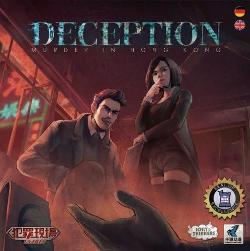
2014 · Bluffing
Deception: Murder in Hong Kong
Players take on secret roles in a murder investigation where one of the investigators is the killer. A designated Forensic Scientist knows the solution but can only communicate via scene tiles; other players interpret those limited clues to identify both the key evidence and the means of murder. Roles are hidden and include investigators, a murderer, and optional accomplice and witness characters. Discussion, accusation, and deduction drive play as investigators try to pin down the correct combination while the murderer (and accomplice, if present) injects misinformation to avoid detection. Rounds last about twenty minutes and reward correct inference over withheld or false information.
- Players
- 4–12 best 7
- Playing time
- 20 min
- Age
- 14+
- Complexity
- 1.6 / 5
About the game
- Design
- Publisher


Expansions
See them in Ludoya Deception: Undercover Allies2017
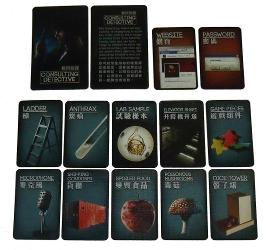 Deception: Murder in Hong Kong – Kickstarter Promo Pack2015
 Deception/CS-Files: Theme Pack – Western Europe2017
 Deception/CS-Files: Theme Pack – North America2017
 Deception/CS-Files: Theme Pack – Southern Europe2017
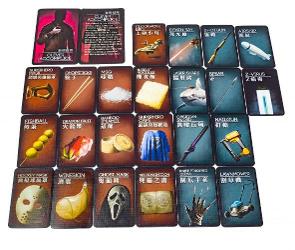 Deception: Undercover Allies – Kickstarter Pack2018
 Deception: Murder in Hong Kong – Game Boy Geek Season 4 Kickstarter Promo Cards2016
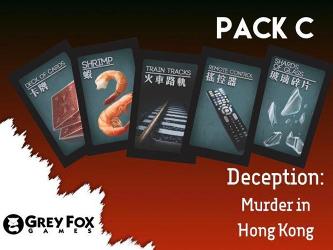 Deception: Murder in Hong Kong – Dice Tower 2017 Indiegogo Promo Pack2017
 Deception: Murder in Hong Kong – Dice Tower 2016 Kickstarter Promo Pack2016
 Deception: Murder in Hong Kong – Dice Tower 2018 Kickstarter Promo Pack2018
 Deception/CS-Files: Premium Role Card Pack2017
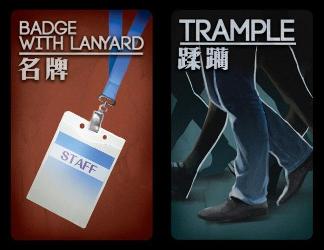 Deception: Murder in Hong Kong – Gen Con 2016 Promo Cards2016
 Deception/CS-Files: Theme Pack – Korea2017
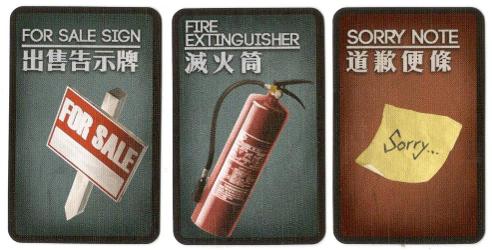 Deception: Undercover Allies – Kickstarter Exclusive "Sorry Pack" Promo Cards2018
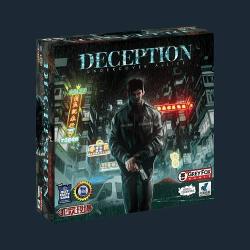 Deception: Undercover Allies – Kickstarter Edition2018
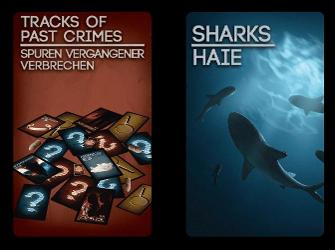 Deception: Murder in Hong Kong – Brazil Promo2019
 Deception/CS-Files: Thai Promo Pack2021
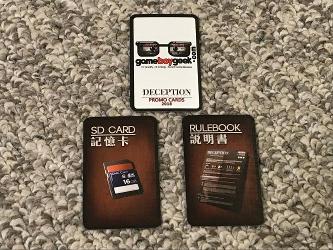 Deception: Murder in Hong Kong – Game Boy Geek Season 6 Kickstarter Promo Cards2018
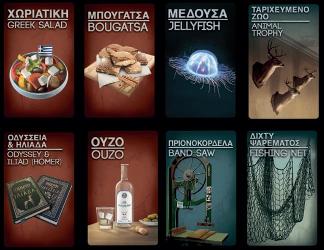 Deception/CS-Files: Greek Promo Pack2021
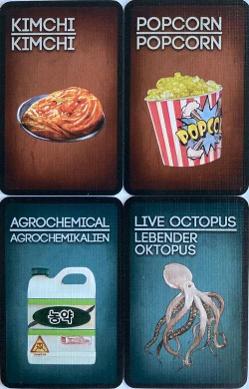 Deception/CS-Files: Theme Pack – Korea II
 Deception/CS-Files: Role Cards – Hong Kong Promo Pack2019
Plays with
See them in Ludoya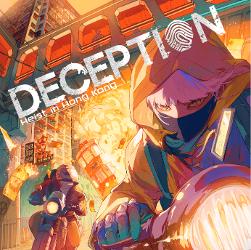
Where to buy it
Shop prices and second-hand copies, checked every day.
On Ludoya's tables
Full stats in Ludoya- 739
- Plays logged
- 718
- Players
- 26m 11s
- Average play
- 149
- In collections
- 22
- On wishlists
7.0/10
from 68 Ludoya reviews
Nevest7.6 This is a fairly simple game that offers a lot of depth and replayability. Over time, you can get better as the Murderer at surveying the environment and picking difficult cards for the Forensic Scientist to give clues for. You can also improve as a Forensic Scientist at playing the word/thought association game to give good clues that catch the Murderer quickly. I will say that certain random setups can make the game much more or less challenging/fun. The general usefulness of the randomly drawn clue option tiles can vary wildly. You might also be lucky enough as the Murderer to have a lot of weapons/evidence similarities with other players. The added roles with more players can offer additional fun (Accomplice and Witness). The expansion also offers more weapons/evidence cards and more roles for additional variability.
Vic Granell8.0 Great party game with a twist from the classic werewolf type of games. Much more information and extra guessing, not just whi the assassin is. Some cards might be more helpful than others, but that's part of the game!
Mestremuten6.0 Rating: 3/5 Production value: 3/4 Is the game in my collection/Love to have?: 0/1


Rules questions
Answered from the rulebook by Ludoya's rules assistant.
Can the Forensic Scientist give hints with words, gestures, or eye contact?
No — the Forensic Scientist may not convey information except through the placement of the bullet markers and by answering “yes” or “no” to a solve attempt; verbal/gestural/eye hints are forbidden (p.1, p.4).
When can I try to "Solve the Crime" and can I try more than once?
Any non-Forensic Scientist player (including the Murderer and Accomplice) may attempt to solve the crime at any time, but each player gets only one attempt; an incorrect attempt costs your badge and you cannot try again (p.4).
Do I have to wait until presentations to make my solve attempt or can I do it during someone’s presentation?
You may interrupt a Presentation only to attempt to solve the crime — attempts are allowed at any time except the Forensic Scientist may not be guessed — but if you don’t attempt before the last player’s third presentation you lose your chance (p.3–4).
How do the Murderer and (optional) Accomplice secretly choose the Key Evidence and Means?
During the closed-eye phase the Forensic Scientist asks the Murderer (and Accomplice) to open their eyes and the Murderer points to one Clue card and one Means card as the solution, acknowledged by the Forensic Scientist’s nod, then they close their eyes again (p.2).
Are players’ Clue and Means cards hidden from others or shown openly?
Each player (except the Forensic Scientist) displays their dealt Clue and Means cards face up in front of themselves with the text visible to all other players; the Forensic Scientist discards their cards and uses the Scene tiles instead (p.2).
If the Investigators correctly identify the solution, can the Murderer still win by naming the Witness?
Yes — when the solution is correctly solved the Murderer may, after conferring with the Accomplice, pick one player as ‘killed’; if that player is the Witness the Murderer and Accomplice escape and win (p.4).











Free, on web, Android and iOS
Play Deception: Murder in Hong Kong with Ludoya
- Keep it in your collectionTrack your copy and its expansions, lend it to friends, or put it on your wishlist and get told when the price drops.Add it to your collection
- Log every playScores, winners, timers and photos, then your stats: win rate, favourite player count, best score.Log a play
- Settle rules questionsAsk anything about the rules and get an answer from the rulebook, with the page to check it on.Ask the rules assistant
- Find people to play it withClubs, game nights and events near you that bring this game to the table.See events
Game facts (players, playing time, age, credits) from BoardGameGeek.