
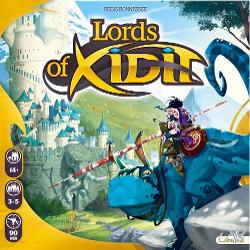
2014 · Fantasy
Lords of Xidit
A fantasy kingdom suffers under a spreading corruption that turns local creatures into raiders. Players act as noble heirs who travel the map recruiting soldiers, reclaiming cities, and building institutions like Sorcerers' Guilds while collecting wealth and prestige. Gameplay uses simultaneous programmed moves each round and a rotating elimination-style scoring: at stages players compare influence in specified categories and the lowest-ranking player is removed along with their forces. The elimination order is randomized each game, forcing varied strategies and careful planning of actions several turns ahead. Includes two promo cards for another title.
- Players
- 3–5 best 4
- Playing time
- 90 min
- Age
- 14+
- Complexity
- 2.6 / 5
About the game
- Design
- Publisher




Expansions
See them in Ludoya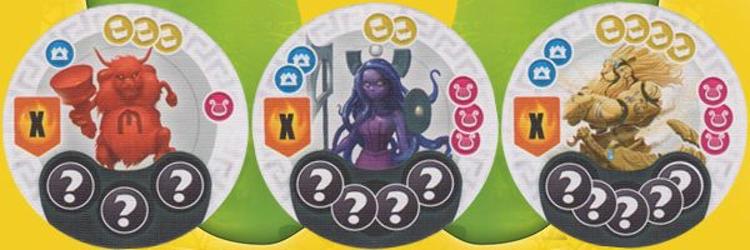
Where to buy it
Shop prices and second-hand copies, checked every day.
On Ludoya's tables
Full stats in Ludoya- 173
- Plays logged
- 263
- Players
- 1h 45m
- Average play
- 83
- In collections
- 6
- On wishlists
6.0/10
from 47 Ludoya reviews
Evan4.6 In this game players log six actions into their secret selection action wheels, then resolve with each player resolving each slot in order. The actions are either, walk along a road in the direction you chose, interact with a token at an intersection space, or pass. The tokens have either ingredients or the opportunity to complete a recipe by discarding the matching arrangement of colored ingredients. When a recipe is completed, the player then chooses to get the benefits from two of it's three reward criteria. Depending on how well you do in the various criteria across the whole game, you might have a shot at winning. This brings me to the oddity of the game. At the start of the game, the three reward criteria are randomized in importance. When you hit endgame scoring, the player (or players at 5p count) who are worst at the criteria automatically lose the game. This means that even if you dominate at the second and third criteria, you might be eliminated from the game from being in last place in the first criteria. Similarly if you push too hard on the first criteria and ignore the second. The three criteria themselves are also a little odd. One is having the most building pieces on the board. The spaces for these buildings is quite limited, and since the rewards claimed from a recipe have to go in a spot next to where you are, your ability to even place these pieces is quite limited and subject somewhat to the randomness of where and when the recipe tiles hit the board. The second odd criteria is having the most money. Money throughout the game is used totally for endgame scoring purposes, and is honestly impossible to track, and is also somewhat subject to what recipes you are able to complete. The third is the strangest. Each region does a majority scoring for whomever put the most and second most markers in the area. One of the potential rewards of completing a recipe is putting out a few of your markers in any adjacent province, which mitigates the luck a little, but honestly not much. This also creates an situation where a player who gets eliminated because they under-invested in the first scoring criteria but overinvested in the majorities criteria still counts as being in those spaces, thus causing players they share spaces with to only get second place or worse for those regions, which might lead to their elimination through no fault of their own other than being in areas with that player, which again isn't that controllable. Strange scoring aside, the core mechanisms of the game, where you try to predict other players and the order they'll go where and do what is really entertaining. The downtime is very low, and I think this fun makes the oddness of the scoring a forgivable quirk, although if scoring was a little more sensible this would be a buy for me, as opposed to my being ok playing a friend's copy every now and then. ★ Art, Iconography and components functional ★ Clever or interesting mechanisms ★ Reasonably low downtime between turns with mildly AP players ★ Multiple plays stay interesting ★ Low or mitigatable luck elements ★☆☆☆☆ Raw enjoyment
Jan Solo7.0 Juego de "pick & delivery" en el que deberás reclutar tropas para vencer a enemigos y convertirte en el salvador del reino de Xidit. Sistema de puntuación muy interesante y gestión oculta de acciones. Sencillo, ideal para jugadores casuales.
Daniel7.5 4,5


Rules questions
Answered from the rulebook by Ludoya's rules assistant.
If I programmed an Action order but the City no longer has a Recruitment or Threat tile when my order resolves, what happens — is my Action wasted or can I do something else?
The Action order is ignored (cancelled) if the City no longer contains the relevant Recruitment or Threat tile when you perform the action; you may not substitute another action (exception: special rules for Raging Titans). (pages 7, 13)
When I recruit from a Recruitment tile, can I choose which Unit to take?
No — you must recruit the least powerful Unit present on that City's Recruitment tile, and you may recruit at most one Unit per Game Year from a given City. (page 7)
What exactly does the Wait order do — can my Idrakys still act or move that turn?
Wait instructs your Idrakys to do nothing for that programmed Order: it neither moves nor performs an action in that position. (pages 6, 9)
When a Recruitment or Threat tile is removed, when and how is it replaced, and what if the piles run out?
When a tile is removed you immediately place the tile from the Next Recruitment/Next Threat space onto the corresponding City and then refill the Next space from the top of the pile; if a pile is empty you replenish it from the opposite discard pile (turned over), and if neither can supply tiles you trigger the Awakening of the Titans/Arrival of Reinforcements. (pages 10–12)
How do Titans (Raging Titan tiles) work — where can they be fought and what Units do they require?
When awakened a Raging Titan behaves like a threat but is not tied to any City: it may be eliminated from any City that does not already contain a Recruitment or Threat tile; the Units required are generic, so the player chooses the required Unit types from behind their screen, and eliminated Titan tiles are removed from the game. (pages 12–13)
If players tie during an Assessment, how are ties resolved and can a tie cause elimination?
Ties in reward/census situations grant each tied player the listed reward, while ties in Hall of Fame ranking are broken first by comparing total Units behind screens and then by proximity to the First Player token if still tied; after ranking the lowest player (or two lowest in a five-player first assessment) is eliminated. (pages 14–16)




Free, on web, Android and iOS
Play Lords of Xidit with Ludoya
- Keep it in your collectionTrack your copy and its expansions, lend it to friends, or put it on your wishlist and get told when the price drops.Add it to your collection
- Log every playScores, winners, timers and photos, then your stats: win rate, favourite player count, best score.Log a play
- Settle rules questionsAsk anything about the rules and get an answer from the rulebook, with the page to check it on.Ask the rules assistant
- Find people to play it withClubs, game nights and events near you that bring this game to the table.See events
Game facts (players, playing time, age, credits) from BoardGameGeek.