
2018 · Ancient
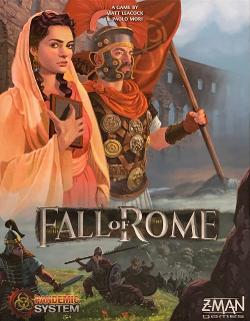
Fall of Rome
Players cooperate as leaders of a weakening empire to repel waves of invading tribes and stabilize provinces. On each turn players move across the map, recruit and deploy armies, fortify cities, and resolve battles against Anglo-Saxons, Goths, Vandals, Huns and other invaders. Matching sets of colored cards are spent to forge alliances with tribes, convert enemy units, and unlock special actions. Distinct roles grant unique abilities and players must coordinate to manage limited resources, stem incursions, and prevent revolts. Includes a solitaire mode where one player controls multiple roles and an optional increased-difficulty variant that alters revolt and garrison rules.
- Players
- 1–5 best 3
- Playing time
- 45–60 min
- Age
- 8+
- Complexity
- 2.5 / 5
About the game
- Design
- Publisher






Where to buy it
Shop prices and second-hand copies, checked every day.
On Ludoya's tables
Full stats in Ludoya- 158
- Plays logged
- 133
- Players
- 1h 7m
- Average play
- 68
- In collections
- 5
- On wishlists
- 1
- Pre-ordered
6.0/10
from 27 Ludoya reviews
Evan3.5 I've said this before, but regular pandemic does nothing for me, and I didn't really get into Pandemic Legacy that much. I really love Pandemic Rising Tide and Pandemic Iberia however, so seeing this was designed by Paolo Mori, I really wanted to try this game. So here's what's different about this version of the game. The harm cubes come onto the board following specific paths leading from their supply pool to the geographic location that is written on the card. Players can then stop their supply chain by placing soldier tokens and forts in their way. New cubes only get added to a space if the space already has a matching cube, or if the location along the path right before the space has a matching cube. If a cube would be added where soldier tokens are standing, the cube isn't added, and all soldiers standing there are removed, unless they are with a player marker or a fort, in which case only one soldier comes off. Rather than finding cures, you are doing the same basic process to form alliances with the different colors of cubes, which doesn't stop them from coming, but does give you a new action option which is replacing the cubes with soldiers. Additionally, the remove cubes action is replaced with a 'fight the cubes' action, which involves rolling dice up to the number of soldiers with you in your space to a maximum of 3 dice. The dice have some combination of 'remove cubes', 'remove soldiers', and 'activate your special unique character combat ability' icons. I suppose the luck element is thematic, but I found this element a little clunky. New soldier tokens generally have to be gotten from forts. Forts have to be defended, but also you can move with up to three soldiers. So you move with 3, roll some dice to remove cubes, wind up doing poorly, then you have to run back and get more soldiers. Alternately, you wind up doing quite well, and remove the enemy cubes, but also roll your special ability that does something cool if there were still enemies, but there aren't so it does nothing. Honestly, the feel of this game is not very different from regular Pandemic which is not a big hit with me. What I love in Iberia and Rising Tide is the minor engine building or route building aspects, and what things game brings to the table is die luck which does nothing for me, and having the cubes flow out of origin spaces in a naturalistic way, which is already in Rising Tide, so I'm going to call this one a miss. ★ Art, Iconography and components functional ★ Clever or interesting mechanisms ★ Reasonably low downtime between turns with mildly AP players ★ Multiple plays stay interesting ☆ Low or mitigatable luck elements ★☆☆☆☆ Raw enjoyment
SrCornelius8.0 Local-(235)

Similar games
 Tetrarchia2015
 Hispania2024
 Kings of Israel2014
 Pandemic: Rising Tide2017
 Fate: Defenders of Grimheim2025
 Horrified: Dungeons & Dragons2025
 The Wars of Marcus Aurelius2018
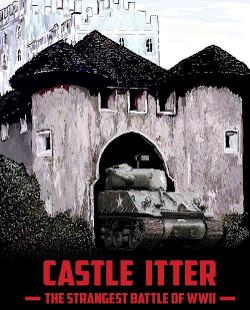 Castle Itter: The Strangest Battle of WWII2019
 Star Wars: The Clone Wars2022
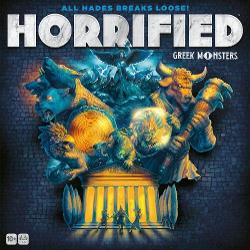 Horrified: Greek Monsters2023
 World of Warcraft: Wrath of the Lich King2021
 Horrified: American Monsters2021






Free, on web, Android and iOS
Play Fall of Rome with Ludoya
- Keep it in your collectionTrack your copy and its expansions, lend it to friends, or put it on your wishlist and get told when the price drops.Add it to your collection
- Log every playScores, winners, timers and photos, then your stats: win rate, favourite player count, best score.Log a play
- Score it without paperUse the community's score sheets and play helpers, and let Ludoya add up the points.Find score sheets
- Find people to play it withClubs, game nights and events near you that bring this game to the table.See events
Game facts (players, playing time, age, credits) from BoardGameGeek.