
2006 · Religious
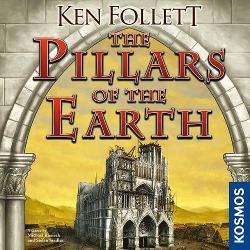
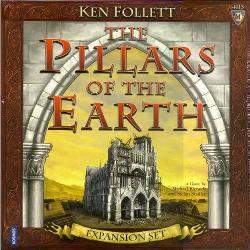
The Pillars of the Earth
Set in 13th-century England, players act as builders competing to contribute to the construction of a great cathedral. Gameplay centers on placing workers to produce raw materials or gold, then assigning craftsmen to convert materials into victory points. Each turn offers three master-builder actions that can recruit workers, buy or sell goods, take early-action privileges for gold, or directly gain points; players balance purchasing better craftsmen and securing gold against scoring. Strategic timing and resource conversion drive the race to score the most victory points by the cathedral’s completion.
- Players
- 2–4 best 4
- Playing time
- 90–120 min
- Age
- 12+
- Complexity
- 2.8 / 5

Where to buy it
Shop prices and second-hand copies, checked every day.
On Ludoya's tables
Full stats in Ludoya- 251
- Plays logged
- 214
- Players
- 1h 35m
- Average play
- 128
- In collections
- 6
- On wishlists
6.7/10
from 64 Ludoya reviews
Mestremuten7.0 Rating: 3/5 Production value: 3/4 Is the game in my collection/Love to have?: 1/1
Garfield2.0 #45
Rules questions
Answered from the rulebook by Ludoya's rules assistant.
During the resource/craftsman draft, can I take more than one card or once I pass I'm out?
Players take cards clockwise until all cards are taken or everyone has passed; you may take multiple cards as the draft proceeds, but if you pass you may not take any more cards that round (p.5).
Do I need a stonecutter/woodworker/mortar mixer to use the market or to score with certain craftsmen?
Yes — without a stonecutter you cannot sell stones, without a woodworker you cannot buy wood, and without a mortar mixer you cannot earn victory points with a mason; these special starting craftsmen grant those market/access benefits (p.1).
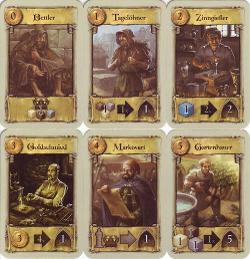
How many craftsmen can I have and what if I acquire a new one when I'm already at five?
You may have a maximum of 5 craftsmen; if you take a craftsman while already at five you must discard one of your current craftsmen to make room, and you may also pay for and immediately discard a craftsman to deny it to others (discarded craftsmen are removed from the game) (p.1, p.5).
At the resource market, how do buying/selling rules work — prices, limits, and can I buy metal?
Players at the market may buy or sell resources in turn (there are at most four cubes of any one resource available); purchase prices are stone 4, wood 3, sand 2 gold each, you cannot buy metal at the market, and selling pays (metal 5, stone 4, wood 3, sand 2); you may not buy and sell the same resource type in the same round (p.7–p.8).
If a master builder is drawn and I don't want or can't pay the current placement cost, what happens when I pass?
You may pass and place your drawn master builder on the cost track above the current value, the cost marker is decreased by 1, and after all builders are drawn the passed builders are placed for free in the order they were passed (leftmost/earliest passed placed first); when you do place a builder you must pay the current cost shown (p.6).
When and how do craftsmen convert resources into victory points — are the resources consumed?
During the Cathedral phase at the end of each round you choose which resources to use and apply each craftsman's formula (resource cost → VP and capacity limits) to score VPs; the resources you use are then returned to the resource fields (removed from your supply) and craftsmen capacities limit how often each formula may be applied (p.8; craftsmen details p.1).


Free, on web, Android and iOS
Play The Pillars of the Earth with Ludoya
- Keep it in your collectionTrack your copy and its expansions, lend it to friends, or put it on your wishlist and get told when the price drops.Add it to your collection
- Log every playScores, winners, timers and photos, then your stats: win rate, favourite player count, best score.Log a play
- Settle rules questionsAsk anything about the rules and get an answer from the rulebook, with the page to check it on.Ask the rules assistant
- Find people to play it withClubs, game nights and events near you that bring this game to the table.See events
Game facts (players, playing time, age, credits) from BoardGameGeek.