
2012 · Economic
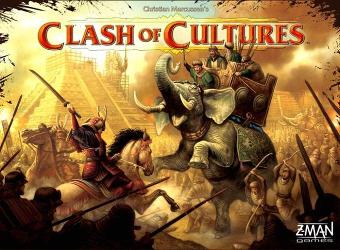
Clash of Cultures
Players guide a civilization from a single settlement through exploration, city-building, research and conquest to create a lasting culture. The game uses a modular, tile-based map that is revealed as settlers move into uncharted regions, with systems to mitigate unlucky tile draws. Cities grow by choosing building types (port, fort, temple, academy, etc.) that grant distinct benefits, and city mood (angry, neutral, happy) affects play. A flexible tech tree of roughly 48 advances presents no dead ends and clearly shows opponents’ progress. Victory points come from founding and expanding cities, advances, objectives, wonders and events.
- Players
- 2–4 best 4
- Playing time
- 180–240 min
- Age
- 14+
- Complexity
- 3.6 / 5
About the game
- Design
- Publisher



Expansions
See them in Ludoya
Where to buy it
Shop prices and second-hand copies, checked every day.
On Ludoya's tables
Full stats in Ludoya- 84
- Plays logged
- 103
- Players
- 3h 27m
- Average play
- 20
- In collections
- 6
- On wishlists
7.0/10
from 25 Ludoya reviews
Balleflass7.0 One of the best Civilization games if not the best. Sold it as I'm waiting for the new edition.
virus3210.0 recomendado, me encanta y estoy buscando la expansión
Mestremuten8.0 Rating: 4/5 Production value: 3/4 Is the game in my collection/Love to have?: 1/1

Rules questions
Answered from the rulebook by Ludoya's rules assistant.
How do I found a city — do I need a Settler and where can I place it?
Spend a Found City action while a Settler is on a non‑Barren land space with no cities or foreign units; replace the Settler with a Settlement piece (each Settler/Found action does one city) (Rulebook pp.6, 8).
How many actions do I get each turn and how do Advances work (do I have to buy the top advance first)?
You get 3 actions per turn; the Advance action normally costs 2 Food (or Ideas) and when you enter a new category you must take the top advance first, after which you may buy other advances in that category (Rulebook pp.7, 5).
Can I move Army units and use Action cards in combat immediately?
You may not Move Army units until you have the Tactics advance, though you can still Build Armies and they can fight if attacked; the Tactics advance is also required to play Action cards for their combat effects (Rulebook pp.9, 12, 7).
When I explore with land units can I rotate region tiles any way I want?
No — when revealing a region you must place it so the space your unit entered is not a Sea, then connect Sea spaces to adjacent Sea if that doesn't violate the first rule, and if neither applies place Sea to touch the map edge if possible; if multiple rotations remain you may choose (Rulebook pp.16–18).
How do combat dice become "hits" and what happens when a city is captured?
Each side rolls one die per Army unit, total those dice for your Combat Value (CV) and divide CV by 5 (rounded down) to get hits; remove one Army per hit (settlers are auto‑defeated) (Rulebook p.12). If an attacker ends a battle alone in a foreign city you exchange the city‑pieces into your color, gain Gold equal to the city's size and the previous owner receives a Settler as refugee, and the city becomes angry (Rulebook p.12).
How does Cultural Influence work — range, success and boosting?
Use one of your cities to target a size‑2+ city within range equal to your city's size (actual size); roll a die (success on 5–6) and on success exchange one non‑Settlement city‑piece into your color; you may spend Culture tokens to add +1 range per token or +1 to the die result per token (tokens to add to the roll may be spent after rolling), and only one successful Cultural Influence may occur per turn (Rulebook pp.10–11).
Similar games
 Clash of Cultures: Monumental Edition2021
 Epochs: Course of Cultures2025
 Sid Meier's Civilization: The Board Game2010
 Dominations: Road to Civilization2019
 Dark Ages: Holy Roman Empire2021
 Dark Ages: Heritage of Charlemagne2021
 Civilization: A New Dawn2017
 Arydia: The Paths We Dare Tread2025
 Bios: Origins (Second Edition)2019
 Age of Innovation2023
 Antiquity2004
 Star Trek: Ascendancy2016
People who own it also own

Free, on web, Android and iOS
Play Clash of Cultures with Ludoya
- Keep it in your collectionTrack your copy and its expansions, lend it to friends, or put it on your wishlist and get told when the price drops.Add it to your collection
- Log every playScores, winners, timers and photos, then your stats: win rate, favourite player count, best score.Log a play
- Settle rules questionsAsk anything about the rules and get an answer from the rulebook, with the page to check it on.Ask the rules assistant
- Find people to play it withClubs, game nights and events near you that bring this game to the table.See events
Game facts (players, playing time, age, credits) from BoardGameGeek.