
2006 · Economic
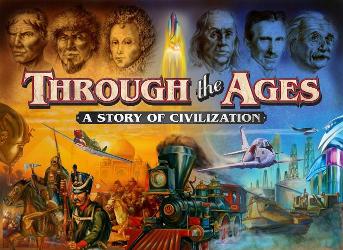
Through the Ages: A Story of Civilization
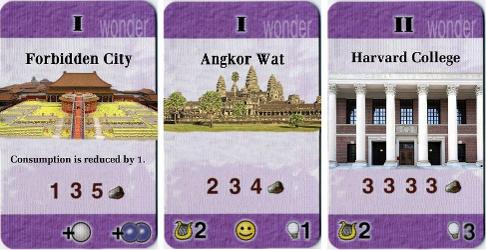
Players guide a civilization from antiquity to the modern age by drafting cards for technologies, leaders, wonders and buildings. Gameplay centers on resource management: producing food to grow population, generating science to research technologies, and using ore and workers to construct buildings while supporting a military. Card drafting and tableau-building determine available actions, and technologies require sufficient science, population and resources to use. Military strength influences interactions: stronger forces can raid resources, science, population, leaders or culture. The game ends in the modern age and the highest culture total wins.
- Players
- 2–4 best 3
- Playing time
- 120 min
- Age
- 12+
- Complexity
- 4.2 / 5
About the game
- Design


Expansions
See them in Ludoya
Where to buy it
Shop prices and second-hand copies, checked every day.
On Ludoya's tables
Full stats in Ludoya- 514
- Plays logged
- 141
- Players
- 2h 56m
- Average play
- 53
- In collections
- 7
- On wishlists
- 1
- Pre-ordered
7.8/10
from 64 Ludoya reviews
Mestremuten6.0 Rating: 5/5 Production value: 1/4 Is the game in my collection/Love to have?: 0/1
andycted8.7 2-3 players A great classic that has efficiency and optimisation at its core and should not be played too often. A fun romp
Fernando7.0 No llegamos a terminar 1 partida por tiempo. Tienes que ir desarrollando tu civilización con mejor sistema de gobierno (que te puede dar más acciones civiles y/o militares, así como más cartas en la mano y más cantidad de trabajadores por recursos), mejores formas de recolectar recursos (alimentos y piedras), cultura, ciencia, potencial militar (para poder atacar, defenderte o ganar los eventos), construir maravillas y obtener líderes que te darán ventajas. Lo malo es que es un juego muy largo, pero me gustó el juego. Las cosas que puedes hacer son realmente escasas para lo que quisieras, porque siempre al mismo tiempo que quieres ir jugando lo que has conseguido en turnos anteriores, también quieres coger nuevas cartas y muchas veces faltan recursos para construirlo todo. A pesar de ser tan largo, no me importaría jugarlo de nuevo y terminar una partida. Y eso dice mucho del juego, ya que no me suelen gustar juegos de tanta duración.
Rules questions
Answered from the rulebook by Ludoya's rules assistant.
Can I play a card from my hand anytime or only on my turn?
You may only play cards when you take the appropriate action on your turn (for example taking/playing Civil, Technology or Military cards); you cannot play cards outside your turn. See rulebook pages 4–5.
What happens if I can't feed my population during production?
During Production you must pay food for your population; if you cannot, you must immediately reduce population (disband workers/units) until you can pay, which can cause loss of workers and other penalties. See pages 6 and 9.
When are Event cards drawn and how do they resolve?
Event cards are drawn and resolved as part of the round sequence (after the first round) and are handled according to the event text; some events are immediate and others are future events with a specific resolution procedure. See pages 8 and 12.
How does combat resolution work — do military cards fight or only units?
Aggression (brown) cards trigger combat that is resolved by comparing military strength from your units (modified by Tactics/Armies and card effects); military cards and tactics change how strength is calculated and are applied during combat resolution. See pages 13 and 16.
How can I change my government — do I have to cause a revolution to switch?
You can change government peacefully by paying the indicated cost when taking the change-government action, or you may trigger a Revolution if you cannot/will not pay; both peaceful change and Revolution procedures are described in the rules. See page 8.
What do happiness and corruption do, and how do uprisings happen?
Happiness affects the risk of uprisings and certain population penalties, while corruption (advanced rule) reduces effective resource production until mitigated; the rulebook explains how happiness, uprisings and corruption interact with examples. See page 15.


People who own it also own
 Maharaja: The Game of Palace Building in India2004
 1860: Railways on the Isle of Wight2004
 Terra Mystica2012
 Neuland2004
 DreadBall: The Futuristic Sports Game2012
 To Court the King2006
 Goa2004
 Wings of War: Famous Aces2004
 1960: The Making of the President2007
 Elasund: The First City2005
 Wings of War: Watch Your Back!2005
 Hannibal: Rome vs. Carthage1996
Free, on web, Android and iOS
Play Through the Ages: A Story of Civilization with Ludoya
- Keep it in your collectionTrack your copy and its expansions, lend it to friends, or put it on your wishlist and get told when the price drops.Add it to your collection
- Log every playScores, winners, timers and photos, then your stats: win rate, favourite player count, best score.Log a play
- Settle rules questionsAsk anything about the rules and get an answer from the rulebook, with the page to check it on.Ask the rules assistant
- Find people to play it withClubs, game nights and events near you that bring this game to the table.See events
Game facts (players, playing time, age, credits) from BoardGameGeek.