
2016 · Mythology
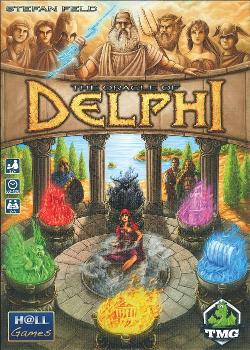
The Oracle of Delphi
Players command ships across a modular hex board of Aegean islands to complete twelve legendary tasks set by Zeus, such as delivering colored offerings to matching temples, erecting structures, and slaying colored monsters. Each turn the player rolls three colored oracle dice that determine which color-dependent actions are available, then takes three actions that may include sailing, visiting islands, performing tasks, hiring companions, or gaining favors from the gods. Variable ship abilities, special tokens, and a changing board setup influence strategy and movement, while dice results and acquired powers allow players to adapt their plans as they race to finish all twelve tasks.
- Players
- 2–4 best 3
- Playing time
- 70–100 min
- Age
- 12+
- Complexity
- 3 / 5





Where to buy it
Shop prices and second-hand copies, checked every day.
On Ludoya's tables
Full stats in Ludoya- 111
- Plays logged
- 121
- Players
- 1h 30m
- Average play
- 46
- In collections
- 10
- On wishlists
- 1
- Pre-ordered
4.6/10
from 20 Ludoya reviews
My favourite Feld game until date. Original, thematic, fun, interactive and with a great theme and great art.
Evan0.9 This is a pickup and deliver game where each turn you roll three dice, and the dice determine your success or failure in terms of being able to make efficient moves. Each round a penalty die is rolled, and if you didn't prepare proper defenses, you take a wound card. Once you have a certain number of those cards, you have to skip a turn which can be harsh. The game has a lot of different ways to mitigate your luck, and some engine building which is nice, but ultimately it's a competent but uninspiring efficiency game. Components-wise, Red and Pink were printed on the tiles to mark them and the color is wayy too close to each other to be functional. The game has reverse sides on the tiles that emphasize symbol over color, but the rulebook doesn't have a mirrored setup diagram, which is incredibly frustrating. ☆ Art, Iconography and components functional ☆ Clever or interesting mechanisms ★ Reasonably low downtime between turns with mildly AP players ☆ Multiple plays stay interesting ★ Low or mitigatable luck elements ☆☆☆☆☆ Raw enjoyment

Rules questions
Answered from the rulebook by Ludoya's rules assistant.
When do I have to Recover for Injury Cards — how many of a color or total, and what happens?
At the start of your turn, if you have 3 equally colored Injury Cards or 6 Injury Cards in total you must use your turn to Recover: discard 3 Injury Cards of your choice and end your turn without Consulting the Oracle (page 5). You can also discard Injury Cards as an action on a later turn (page 11).
When I Consult the Oracle at the end of my turn, can I advance my own Gods with those colors?
No — when you Consult the Oracle other players may advance one of their Gods that matches the announced colors, but you may not advance any Gods at that moment (page 5).
Do I get a Zeus Tile's reward immediately when I complete its task, or only when the tile is returned?
A Zeus Tile's reward is only given when the Zeus Tile is returned to the box, so you must return the completed tile to receive its reward (page 6).
Can I use my Oracle Dice and also play an Oracle Card in the same turn?
Yes — during phase 2 you may use your Oracle Dice for actions and you may additionally use one Oracle Card per turn (place it next to your board to show it's used and discard it at end of turn) (page 5; Oracle Cards on page 7).
When moving my Ship, must the destination match the die color and can I cross shallows or islands?
You may move up to 3 water spaces (pay 1 Favor per extra space) and your movement must end on a water space matching the used die color; you may not cross or stop on island spaces or shallows unless a Ship Tile, Companion or Equipment Card specifically allows it (movement rules page 10; equipment that affects shallows page 9).
How does fighting a Monster work — rounds, injuries, and Favor token use?
Each Monster starts at strength 9 reduced by your Shield, you roll the Battle Die each round and defeat the Monster if your roll is equal or higher than its current strength; rolling a 0 draws an Injury Card, and after a lost round you may pay 1 Favor Token to reduce the Monster's strength by 1 and continue (or surrender without further penalty) (page 10).






Free, on web, Android and iOS
Play The Oracle of Delphi with Ludoya
- Keep it in your collectionTrack your copy and its expansions, lend it to friends, or put it on your wishlist and get told when the price drops.Add it to your collection
- Log every playScores, winners, timers and photos, then your stats: win rate, favourite player count, best score.Log a play
- Settle rules questionsAsk anything about the rules and get an answer from the rulebook, with the page to check it on.Ask the rules assistant
- Find people to play it withClubs, game nights and events near you that bring this game to the table.See events
Game facts (players, playing time, age, credits) from BoardGameGeek.