
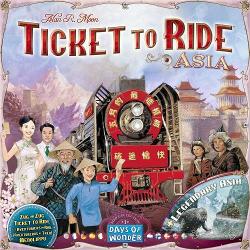
2011 · Expansion for Base-game
Ticket to Ride Map Collection 1: Asia + Legendary Asia
Two double-sided maps set different challenges on the Asian continent. One map uses team play: four or six players form two-player teams, each with private hands and shared cardholder and ticket mechanics, scoring collectively while teammates coordinate claiming routes. The other map adds mountain routes that require placing reserve trains into a Mountain Crossing area when claimed, awarding points but removing those trains from future use; it also awards a bonus for the largest connected network of cities. Requires the base Ticket to Ride game (or Ticket to Ride: Europe) to play.
- Players
- 2–6 best 4
- Playing time
- 30–60 min
- Age
- 8+
- Complexity
- 2 / 5
About the game
- Publisher





Expansion for
See them in Ludoya

Expansions
See them in Ludoya

Photos from Ludoya tables
All photos in LudoyaWhere to buy it
Shop prices and second-hand copies, checked every day.
On Ludoya's tables
Full stats in Ludoya- 99
- Plays logged
- 117
- Players
- 33m 58s
- Average play
- 64
- In collections
- 6
- On wishlists
- 2
- Pre-ordered
7.5/10
from 17 Ludoya reviews
Mestremuten6.0 Rating: 3/5 Production value: 3/4 Is the game in my collection/Love to have?: 0/1
Rules questions
Answered from the rulebook by Ludoya's rules assistant.
When I draw train cards, which card goes to my hand and which goes to the team's shared pile? What about locomotives?
When you draw two train cards you must place one in your hand and the other in your team's common Train cardholder; after revealing the first card you immediately decide whether it goes to your hand or the cardholder and the second card goes to the other location. If you draw a single face-up Locomotive, it must be placed in the common cardholder. (page 2)
Can I use cards from my teammate's hand to claim routes, or only cards in the shared cardholder?
You may use any combination of Train cards from your own hand and/or those in your team's common cardholder to claim a route, but you cannot use cards kept privately in your teammate's hand. (page 2)
How do Destination Tickets work with teams—what do we keep and what do we share at the start and when drawing more?
At game start each player is dealt 5 Tickets and must keep at least 3; once both teammates have chosen, they simultaneously place 1 kept Ticket into the team's common Tickets cardholder so the team starts with 2 shared Tickets. When drawing mid-game a player draws 4 Tickets, must keep at least 1, and then places 1 of the newly kept Tickets into the team's common cardholder while keeping the others secret; rejected Tickets go to the bottom of the deck. (page 2)
Can teammates freely tell each other what they have or pass cards to one another?
Teammates may make light talk but may not exchange game information except as allowed by the cardholder rules; the only formal sharing is placing cards into the team's common cardholders, and a player may spend a whole turn to place up to 2 Destination Tickets from his hand onto the common Tickets cardholder (and do nothing else that turn). (page 2)
How do tunnels work—what counts as a match, what if I can't pay extra cards, and how do locomotives behave?
To claim a Tunnel you first lay down the required cards, then reveal the top 4–6 cards (as indicated); for each revealed card that matches the color used to claim the Tunnel (including locomotives) you must play an additional card of that color or a locomotive from your hand or shared cards, otherwise you may take your played cards back and end your turn; the revealed cards are discarded. Locomotives are wild and count as matches; if you claimed the Tunnel using only locomotives, only additional locomotives drawn count as matches; if there are too few cards to reveal, reveal what exists and if none can be revealed the Tunnel can be claimed without extra risk. (page 2)
Free, on web, Android and iOS
Play Ticket to Ride Map Collection 1: Asia + Legendary Asia with Ludoya
- Keep it in your collectionTrack your copy and its expansions, lend it to friends, or put it on your wishlist and get told when the price drops.Add it to your collection
- Log every playScores, winners, timers and photos, then your stats: win rate, favourite player count, best score.Log a play
- Settle rules questionsAsk anything about the rules and get an answer from the rulebook, with the page to check it on.Ask the rules assistant
- Find people to play it withClubs, game nights and events near you that bring this game to the table.See events
Game facts (players, playing time, age, credits) from BoardGameGeek.