
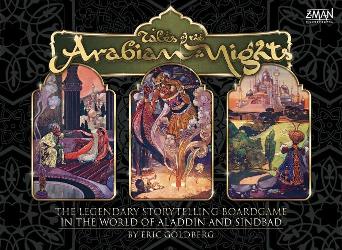
2009 · Fantasy
Tales of the Arabian Nights
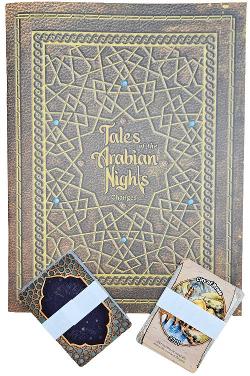
Explore a world of Arabian legends as a hero or heroine seeking destiny and fortune. Players choose a character, pick a quest and skills, and move around the board with movement influenced by wealth. At the end of each move a player draws an encounter card and resolves it by rolling dice and consulting story tables on their character sheet and in a shared Book of Tales. Neighbors influence outcomes by selecting which story options are used, creating collaborative and unpredictable narrative scenes. The first player to fulfill their quest wins, while the game emphasizes unfolding, telling and replayable encounters drawn from a large collection of tales.
- Players
- 2–6 best 3
- Playing time
- 120 min
- Age
- 14+
- Complexity
- 2.2 / 5





Where to buy it
Shop prices and second-hand copies, checked every day.
On Ludoya's tables
Full stats in Ludoya- 116
- Plays logged
- 112
- Players
- 2h 29m
- Average play
- 69
- In collections
- 12
- On wishlists
6.0/10
from 34 Ludoya reviews
Really Unique Adventure Board Game. A classic game that it's a mix between a RPG and an 'Choose Your Own Adventure Book' with Arabic Fantasy theme. Beautiful, surrealistic, and hyper funny! If there is much people playing can be very long, but with 3-4 players it's an awesome experience.
Evan3.5 You build a rudimentary character and then move around the board having adventures. The "goal" of the game is to get 20 points in some combination of points and then make it back to the city at the center of the board. For your own sanity, ignore scoring other than as an end game timer. The real goal of the game is to just have a wonderful time seeing where everyone's stories take them. It's less of a "game" and more of a giant multiplayer choose your own adventure book, where each encounter gives you 5 or 10 different ways you can react to the situation. Sometimes, it can be a little ambiguous as to what you chose to do at any point, for example, I had an encounter with "Dark Creatures" and I looked at my options and saw I could pick "Aid". I was thinking this would be 'aid the dark creatures' but as it happens when the book was read I had actually chosen to aid the previously unmentioned victims of said dark creatures for which I was rewarded handsomely. Still fun, but maybe a little confusing. Another example was we had a player who encountered a small treasure. He was like, sure I'll take it, and chose "take". This lead to the book describing a scene of thievery that the player had not really intended. Despite this, everyone had a marvelous time getting into the stories that unfolded. Player's only real complaint was that with 6, the time between turns was a little too long.

Rules questions
Answered from the rulebook by Ludoya's rules assistant.
When do I choose my starting skills and how many do I get?
You choose your starting skills during setup as described in the setup/starting-game section; follow the selection steps there to take the correct number of skills for your character (page 3).
Do I pick a reaction before I read the encounter result paragraph or after I roll the Destiny Die?
You choose your reaction from the encounter’s reaction matrix as part of resolving the encounter, then roll the Destiny Die and read the corresponding result paragraph to see the outcome (pages 5–6).
What does the word “other” mean when it appears in a result paragraph?
The rulebook defines how to interpret “other” in result paragraphs—use the paragraph’s context to apply “other” to any targets or items not explicitly named, following the guidance on resolving ambiguous references (page 7).
Can I sell treasures immediately for wealth, and how does wealth move?
You may sell treasures according to the rules for wealth and selling treasures; the procedure for selling and how wealth tokens move is explained in the wealth section, and wealth movement rates are detailed under movement/wealth on the board (pages 8 and 4).
What happens if my character dies — am I out of the game?
Death and its consequences are handled by the death rules; consult the death section for the exact procedure and how death affects your game state and any endgame conditions (page 8).
How do Places of Power work and do they change movement?
Places of Power are special locations with effects explained in the movement/Places of Power section; their specific effects and any interaction with normal movement are described in the movement rules (page 4).
Similar games
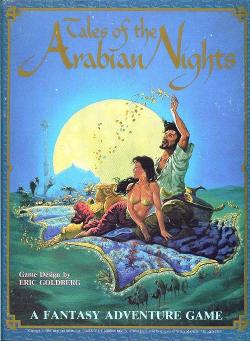 Tales of the Arabian Nights1985
 Tales of the Arthurian Knights2024
 Vantage2025
 Runebound (Third Edition)2015
 D6: Dungeons, Dudes, Dames, Danger, Dice and Dragons!2020
 Forgotten Waters2020
 Roll Player Adventures2021
 Lands of Galzyr2022
 Arydia: The Paths We Dare Tread2025
 The Lord of the Rings: Journeys in Middle-Earth2019
 HeroQuest: First Light2025
 Aftermath2019
People who own it also own
 1313 Dead End Drive2002
 Artisans of Splendent Vale2022
 Blockbuster Returns2020
 Royals2014
 Shadows over Camelot2005
 Ghost Stories2008
 Fury of Dracula (Third/Fourth Edition)2015
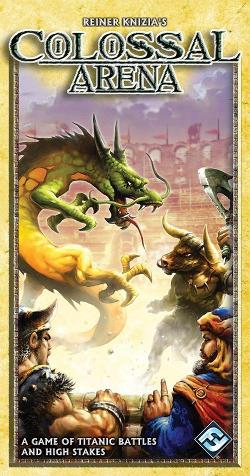 Colossal Arena1997
 Firefly: The Game2013
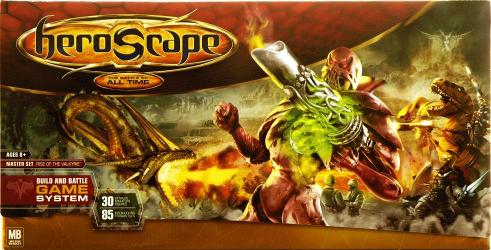 Heroscape Master Set: Rise of the Valkyrie2004
 Nothing Personal2013
 Back to the Future: Back in Time2020
Free, on web, Android and iOS
Play Tales of the Arabian Nights with Ludoya
- Keep it in your collectionTrack your copy and its expansions, lend it to friends, or put it on your wishlist and get told when the price drops.Add it to your collection
- Log every playScores, winners, timers and photos, then your stats: win rate, favourite player count, best score.Log a play
- Settle rules questionsAsk anything about the rules and get an answer from the rulebook, with the page to check it on.Ask the rules assistant
- Find people to play it withClubs, game nights and events near you that bring this game to the table.See events
Game facts (players, playing time, age, credits) from BoardGameGeek.